After manufacturing air filters for over a decade and serving more than two million households, we've learned that annual maintenance isn't just about preventing breakdowns. It's about protecting the heated air circulating through your home before it reaches your family.
This checklist covers every critical task — heating elements, air filters, electrical connections, and safety controls — with the kind of specific, practical guidance that only comes from working closely with homeowners and their systems year after year.
TL;DR Quick Answers
What Is an Electric Furnace and How Does It Work?
An electric furnace is a central heating system that warms air using electric resistance heating elements and distributes it through your home via a blower and duct system. Here is how it works:
The thermostat calls for heat and signals the control board.
Heating elements activate in stages to manage electrical load.
The blower pulls room air through the return filter and across the heated elements.
Warm air moves through the supply ducts and into your living spaces.
A high-limit safety switch monitors temperature and shuts the system down if it overheats.
Key facts every homeowner should know:
Electric furnaces operate at 95 to 100 percent AFUE efficiency at the point of use.
They produce no combustion byproducts — no carbon monoxide, no flue, no gas line required.
Performance depends on three things: clean filters, tight ducts, and annual maintenance.
The most common cause of failure is restricted airflow from a neglected filter — not mechanical breakdown.
After manufacturing air filters for over a decade and serving more than two million households, we've found that electric furnace owners who stay on a consistent filter replacement and annual maintenance schedule experience fewer breakdowns, lower energy bills, and longer equipment life than those who don't.
Top Takeaways
Your air filter is the first line of defense — and the most common point of failure.
Check it monthly.
Replace it every 30 to 90 days based on dust load, pets, and runtime.
A clogged filter triggers a chain reaction: restricted airflow, overworked heating elements, tripped limit switch, higher energy bills.
Electric furnaces are reliable by design — but only with consistent upkeep.
No combustion means no carbon monoxide risk.
Neglected electrical connections, worn elements, and dirty blower assemblies create their own costly problems.
Annual inspection of every major component is what keeps reliability intact.
Duct leakage quietly cancels out your furnace's efficiency advantage.
Electric furnaces operate at 95 to 100 percent AFUE at the point of use.
Leaky ducts can lose 20 to 30 percent of heated air before it reaches a single room.
Sealing accessible duct connections is one of the highest-return tasks on this checklist.
The breakdown pattern is predictable — and preventable.
Deferred filter changes restrict airflow.
Restricted airflow overheats components.
Overheated components fail ahead of schedule.
Annual maintenance interrupts this sequence before it starts.
Maintenance is a protection strategy, not a repair strategy.
The lowest long-term operating costs belong to homeowners who prevent problems.
React to problems and you pay repair prices.
Prevent them and you pay maintenance prices.
Why Annual Electric Furnace Maintenance Matters
Electric furnaces are often considered low-maintenance because they don't rely on combustion fuel — no gas lines, no burners, no carbon monoxide risk. But in our experience working with homeowners across the country, that assumption is exactly what leads to preventable breakdowns and rising energy bills.
Electric resistance heating is efficient by design. Clean HVAC filters help support that efficiency, improve airflow, and keep the system performing at its best. An annual maintenance check takes less than a few hours and protects both your equipment and the air quality of every room it heats.
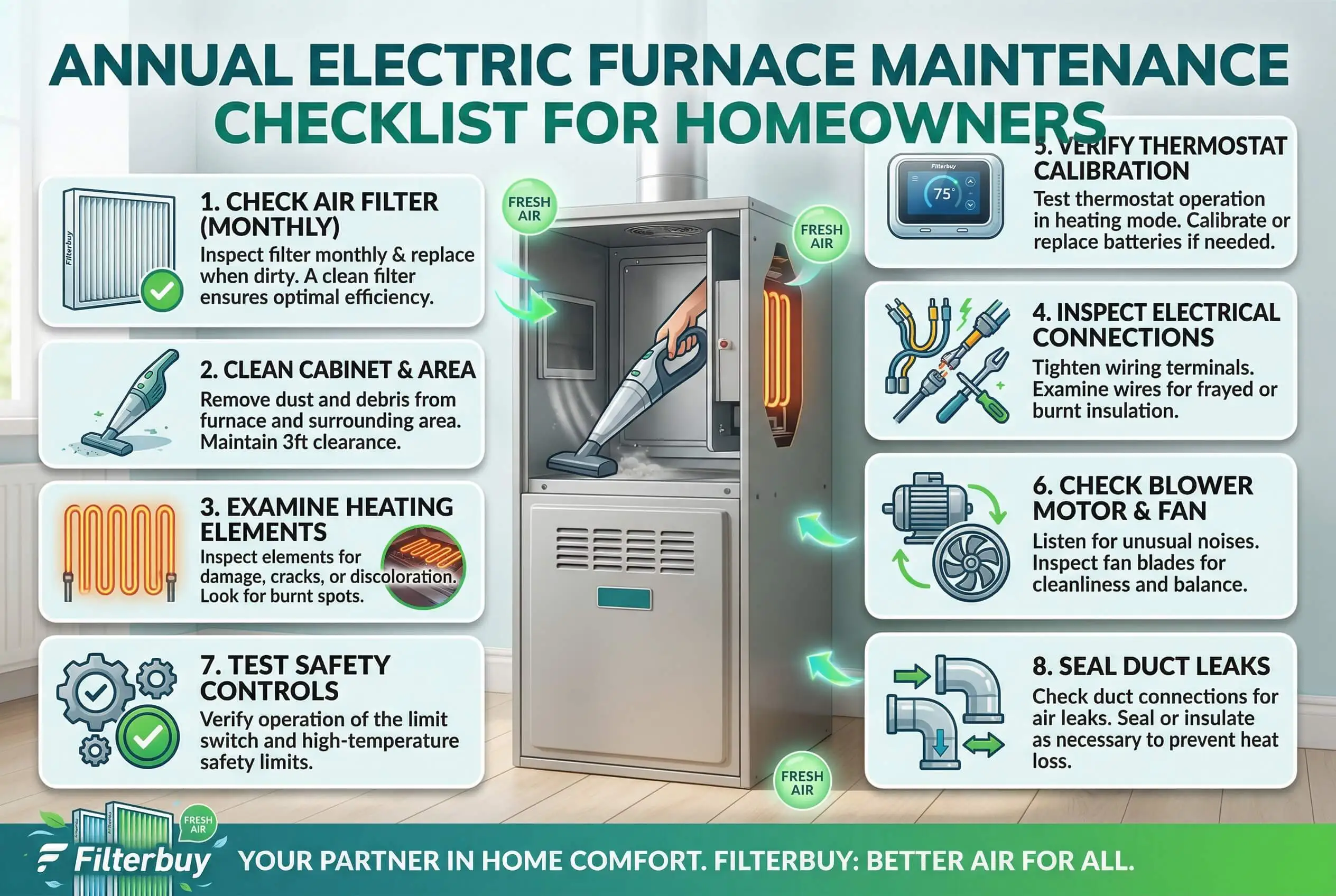
Inspect and Replace the Air Filter
The air filter is the single most important maintenance item on this checklist — and the most frequently neglected. A clogged filter restricts airflow to the point where heating elements overheat, the system short-cycles, and indoor air quality drops without any visible warning sign.
For most homes, a filter replacement every 30 to 90 days is standard. Homes with pets, allergy sufferers, or higher dust levels benefit from monthly changes. After serving over two million households, we've found that homeowners who stay on a consistent filter replacement schedule report fewer service calls and lower monthly energy costs across the board.
Check the filter first. If it's gray, matted, or visibly loaded with debris, replace it before completing the rest of this checklist.
Inspect the Heating Elements
Electric furnaces heat air through a series of resistance heating elements — typically between two and five sequenced coils that activate in stages based on demand. Over time, these elements can crack, corrode, or fail partially without triggering a complete system shutdown.
During your annual check:
Visually inspect each heating element for visible damage, discoloration, or burnt residue
Listen for unusual buzzing or clicking when the furnace cycles on
Note any zones in your home that feel noticeably cooler than others — this can indicate a failed element
A partially failed element forces the remaining coils to work harder, shortens their lifespan, and increases electricity consumption. Catching it early is far less expensive than a mid-season replacement.
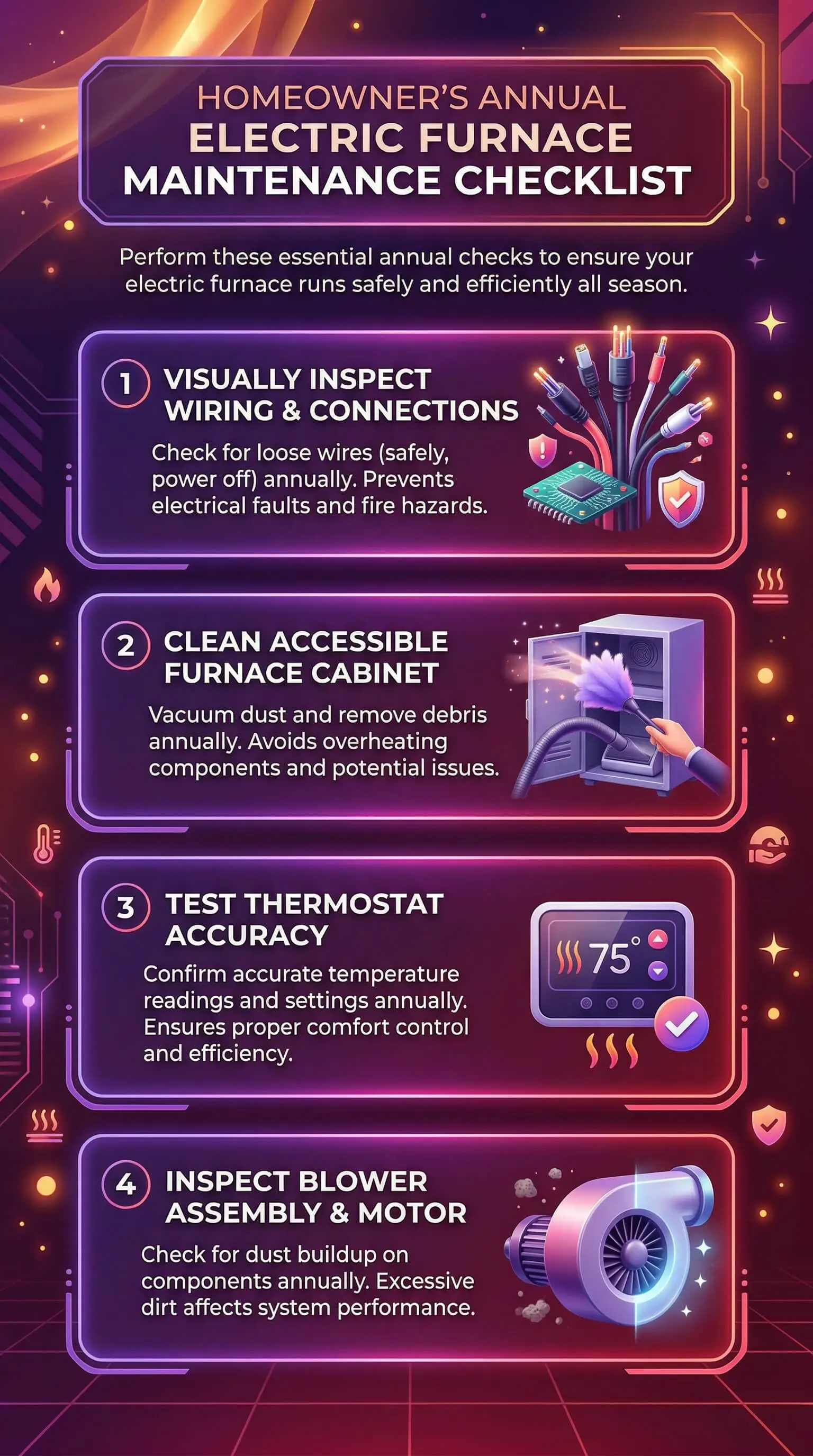
Check Electrical Connections and Components
Electric furnaces operate at high voltages — typically 240 volts — making loose or corroded electrical connections both a safety concern and a performance issue. Vibration from normal operation can loosen terminal connections over time, causing resistance that generates heat, increases energy use, and accelerates component wear.
With the power fully disconnected at the breaker:
Inspect wiring and terminal connections for corrosion, fraying, or discoloration
Check the sequencer relays that control staged heating element activation
Inspect the contactor for pitting or carbon buildup
If you're not comfortable working near electrical panels or high-voltage components, this is the step to hand off to a qualified HVAC technician.
Test the Limit Switch and Safety Controls
The high-limit switch is one of the most critical safety components in an electric furnace. It monitors heat exchanger temperature and shuts the system down if it detects overheating — protecting both the furnace and your home.
A dirty filter or blocked return air vent is the most common reason a limit switch trips. If yours has tripped repeatedly, that's a signal to look upstream at airflow restriction before simply resetting it.
During annual maintenance:
Confirm the limit switch resets properly after a normal heating cycle
Test the system's response to a blocked return vent to verify the switch activates
Check that the blower door safety switch cuts power when the access panel is removed
Inspect the Blower Motor and Fan Assembly
The blower motor circulates heated air from the furnace through your duct system and into your living spaces. A motor running with dirty fan blades, worn bearings, or inadequate lubrication uses more electricity and delivers less airflow.
Annual blower maintenance includes:
Cleaning fan blades of dust and debris buildup
Listening for grinding, squealing, or rattling during operation — all signs of bearing wear
Lubricating motor bearings if the motor type requires it (check manufacturer specifications)
Confirming the blower runs at the correct speed for your system's airflow requirements
A clean, properly functioning blower is the difference between even, efficient heat distribution and cold spots throughout the home.
Verify Thermostat Accuracy and Operation
A thermostat that reads incorrectly — even by a few degrees — causes the furnace to run longer than necessary or shut off before the home reaches the target temperature. Both scenarios waste energy and create comfort inconsistencies.
During annual maintenance:
Compare thermostat readings against a separate indoor thermometer
Test heating mode response time after calling for heat
Check battery condition if the unit is battery-operated
If using a programmable or smart thermostat, review and update seasonal schedules
Inspect Ductwork for Leaks and Blockages
Your ductwork is the delivery system for every BTU your furnace produces. Leaky or blocked ducts can waste 20 to 30 percent of heated air before it reaches the rooms it's meant to warm — a hidden inefficiency most homeowners never connect back to their furnace performance.
During your annual inspection:
Check accessible duct joints and connections for gaps, separated seams, or failing tape
Confirm all supply and return registers are open and unobstructed
Listen for whistling or rushing air sounds from duct runs during operation
Sealing duct leaks with mastic sealant or metal-backed tape is one of the highest-return improvements a homeowner can make to electric heating efficiency.
Schedule a Professional Inspection for High-Voltage Components
Annual maintenance tasks like filter changes, visual inspections, and thermostat calibration are well within reach for most homeowners. But electric furnaces involve high-voltage electrical systems that warrant a professional eye at least once every few years — or any time you notice unusual behavior.
Contact a qualified HVAC technician if you observe:
Repeated tripping of circuit breakers
Burning smell or visible scorch marks near electrical components
Inconsistent heating that doesn't resolve after filter replacement
Error codes on a digital thermostat or furnace control board
In our experience, the homeowners who combine their own annual checklist with periodic professional inspections get the longest service life from their equipment and the fewest unplanned repair costs.
"Most homeowners assume their electric furnace is fine as long as the heat comes on — but that's not the same as the system running safely or efficiently. After working closely with over two million households, we've seen the same pattern repeat itself: a clogged filter restricts airflow, the heating elements overheat to compensate, the limit switch starts tripping, and what started as a five-minute filter change turns into a service call. Annual maintenance isn't about fixing what's broken. It's about understanding what your system is quietly telling you before it stops telling you at all."
Essential Resources
7 Resources That Make Electric Furnace Maintenance Easier to Get Right
Most homeowners search for electric furnace maintenance information after something goes wrong. These seven government resources help you stay ahead of the problem — covering efficiency ratings, filter selection, indoor air quality, and when repair costs signal it's time to replace. After manufacturing air filters for over a decade and working with more than two million households, we know the homeowners who reference authoritative guidance before the heating season experience fewer breakdowns and lower energy bills year after year.
Check Your Furnace's Efficiency Rating Against Federal Standards The U.S. Department of Energy explains how electric furnace efficiency is measured, what AFUE ratings mean in real operating costs, and when upgrading aging equipment makes financial sense. If your system is more than 15 years old, this resource helps you understand what current standards require. https://www.energy.gov/energysaver/furnaces-and-boilers
Know What a Qualified Technician Should Do Every Visit ENERGY STAR's official HVAC maintenance checklist outlines every task a professional should complete during an annual inspection — controls, filters, startup cycle, and system operation. Use it to hold your technician accountable and confirm nothing gets skipped. https://www.energystar.gov/saveathome/heating-cooling/maintenance-checklist
Cut Heating Costs With Simple, Proven System Habits ENERGY STAR's heating and cooling efficiency guide covers filter maintenance schedules, duct sealing, and smart thermostat use — the three improvements that consistently lower monthly energy costs without major equipment changes. Start here before investing in upgrades. https://www.energystar.gov/saveathome/heating-cooling
Follow a Practical Plan for Year-Round HVAC Performance This ENERGY STAR resource walks through filter replacement steps, how to spot duct leakage, and when to schedule professional service before peak heating season demand drives up wait times. It pairs directly with the checklist above. https://www.energystar.gov/products/ask-the-experts/how-keep-your-hvac-system-working-efficiently
Pick the Right Filter for Your System and Your Family The EPA's guide on residential air filtration explains MERV ratings, replacement intervals, and how filter efficiency affects the particulate matter circulating through your home every time your furnace runs. In our experience, most homeowners are running a filter that's either too restrictive or not efficient enough for their household's actual needs. https://www.epa.gov/indoor-air-quality-iaq/guide-air-cleaners-home
Understand What Your Furnace Is Actually Moving Through Your Home Most forced-air heating systems don't bring fresh air in from outside — they recirculate what's already there. The EPA's indoor air quality resource explains what that means for your family during the heating season and what steps, beyond filter changes, reduce indoor pollutant levels. https://www.epa.gov/indoor-air-quality-iaq/improving-indoor-air-quality
Compare Efficiency Tiers Before Your Next Equipment Decision When annual maintenance reveals that repair costs are approaching replacement value, the U.S. Department of Energy's purchasing guidance covers ENERGY STAR qualification levels, lifetime energy cost comparisons, and available utility rebates. Use this resource before committing to a repair on a system that may owe you nothing. https://www.energy.gov/femp/purchasing-energy-efficient-residential-furnaces
Supporting Statistics
Numbers don't protect your home. Understanding what they mean. After manufacturing air filters for over a decade and working with more than two million households, we've seen what these statistics look like in real systems — and what changes when homeowners act on them.
Your Furnace Is Your Biggest Energy Expense
Heating and cooling account for approximately 48 percent of the average home utility bill Department of Energy — the single largest energy expense in most households.
Annual maintenance is how you protect that investment before it becomes a repair bill.
Duct Leakage Is the Hidden Drain Most Homeowners Miss
In typical homes, 20 to 30 percent of air moving through the duct system is lost to leaks, holes, and poorly connected ducts. ENERGY STAR
Most homeowners blame the furnace for cold spots and high bills. In our experience, the duct system is frequently the real cause.
Leaky ducts can reduce heating and cooling system efficiency by as much as 20 percent. ENERGY STAR
For an electric furnace already operating at 95 to 100 percent AFUE efficiency, that downstream loss erases much of the advantage electric resistance heating offers.
Maintenance Produces Measurable Results
Combining proper equipment maintenance with insulation, air sealing, and thermostat management can cut heating and cooling energy use by 20 to 50 percent. Department of Energy That range reflects the real difference between a well-maintained system and a neglected one. Here is what drives those savings:
Annual filter replacement prevents airflow restriction that forces heating elements to overwork.
Electrical connection checks catch resistance buildup before it accelerates component wear.
Duct sealing recovers heated air that would otherwise be lost before reaching living spaces.
Thermostat calibration ensures the system runs only as long as necessary.
Adjusting thermostat settings by 10 to 15 percent for eight hours a day reduces annual heating and cooling costs by as much as 10 percent. Department of Energy
Deferred Maintenance Costs More Than the Repair
Improper installation and neglected maintenance can reduce system efficiency by up to 30 percent, increasing utility costs and shortening equipment life. ENERGY STAR
A furnace running with a clogged filter, loose connections, or a failing heating element isn't just inefficient — it's aging faster than it should.
Consistent annual maintenance is the lowest-cost way to extend equipment life and avoid mid-season breakdowns.
Final Thoughts
An electric furnace is one of the most reliable heating systems a homeowner can own. No combustion, no flue, no pilot light. When something goes wrong, it almost always traces back to something annual maintenance would have caught.
After manufacturing air filters for over a decade and working with more than two million households, our position is straightforward: homeowners who treat this checklist as a non-negotiable annual routine rarely need emergency service calls. That's not a coincidence. It's cause and effect.
What Neglect Actually Looks Like
In our experience, electric furnace problems follow a predictable pattern:
A filter goes too long between changes.
Airflow drops and heating elements run longer cycles to compensate.
The limit switch begins tripping intermittently.
Energy bills rise without an obvious explanation.
A component fails — with two or three others already stressed beyond their intended operating range.
This checklist exists to interrupt that pattern before it starts.
Our Honest Take
Electric furnace maintenance doesn't require advanced skills, specialized tools, or significant time. What it requires is consistency:
Replace the filter on schedule.
Inspect electrical connections annually.
Check the blower and heating elements before the heating season.
Calibrate the thermostat before the first cold snap.
These aren't heroic efforts. They're the quiet, disciplined habits that protect one of the most important systems in your home.
The homeowners who get the most from their equipment aren't the ones who respond fastest when something breaks. They're the ones who make sure it rarely does.
FAQ on Electric Furnace
Q: How often should I service my electric furnace?
A: Once a year — before the heating season begins. Cover these five areas at minimum:
Filter replacement
Heating element inspection
Electrical connection checks
Blower motor cleaning
Safety control testing
After working with more than two million households, we've found one consistent pattern: systems that receive annual attention last 20 to 30 years. Systems that don't, fail early. Skipping a year doesn't mean skipping a problem. It means delaying one.
Q: What is the most important maintenance task for an electric furnace?
A: Filter replacement — and it's not close. A neglected filter triggers a chain reaction:
Airflow restricts the heating elements.
Elements overheat and run longer cycles.
The limit switch begins tripping.
Electricity costs rise without explanation.
Components fail ahead of schedule.
Check the filter monthly. Replace it every 30 to 90 days based on dust load, pets, and runtime. It is a five-minute task that prevents hundred-dollar repair calls.
Q: How do I know if my electric furnace heating elements are failing?
A: Partial element failure is easy to miss — the system keeps running, just harder than it should. Watch for these warning signs:
Rooms that stay colder than others despite normal system operation.
Heating cycles that run longer but never reach the target temperature.
Buzzing or clicking sounds on startup that weren't there before.
Visible scorch marks or discoloration on elements during inspection.
The hidden risk: surviving elements absorb the extra load. By the time a second element fails, the system has been running under stress for weeks or months.
Q: Does an electric furnace affect indoor air quality?
A: More than most homeowners expect. Here is what most people miss:
An electric furnace does not introduce fresh outdoor air.
It recirculates the same indoor air repeatedly throughout the heating season.
Every pass through the system is an opportunity to filter what is already in your home.
After manufacturing filters for over a decade, we know the gap between a MERV 8 and a MERV 13 filter is not just a number. It is the difference between capturing basic dust and capturing the fine particulate matter that affects respiratory health. Use the highest MERV rating your system's airflow can accommodate.
Q: When should I replace my electric furnace instead of repairing it?
A: Apply this framework before committing to any major repair:
Age: Systems older than 20 years are approaching the end of reliable service life.
Repair cost: Any single repair exceeding 50 percent of replacement cost tips the math toward replacement.
Frequency: Multiple repairs in one heating season signal systemic wear — not isolated failure.
Energy bills: A steady rise in electricity costs without a usage change points to declining efficiency.
Performance: Persistent temperature complaints after a clean filter and functioning components suggest the system can no longer meet the home's heating load.
In our experience, homeowners who wait one repair too long end up replacing equipment reactively — at peak season pricing, with limited availability, and no time to compare options.
Keep Your Electric Furnace Running at Its Best Year After Year
Your annual electric furnace maintenance checklist is only as effective as the filter protecting your system — and Filterbuy makes it easy to stay on schedule with USA-made filters in over 600 sizes, delivered directly to your door. Find your filter size today and take the first step toward a cleaner, more efficient heating season.