We've shipped filters to Florida homes long enough to know what that climate does to a filtration decision. MERV 8 leaves too much behind in a state where humidity feeds mold growth year-round. MERV 13 cleans aggressively — but most standard residential systems weren't built for that level of resistance, and a strained system trades air quality gains for higher energy bills and premature wear.
The right rating isn't just about what the filter catches. A 20x20x1 air filter delivers the balance your HVAC system can sustain while improving overall performance and air quality. This page covers both.
TL;DR Quick Answers
20x20x1 air filter
A 20x20x1 air filter is one of the most common residential HVAC filter sizes in the U.S. — 20 inches long, 20 inches wide, and 1 inch thick. It slides into your system's return air slot to capture airborne particles before they cycle through your equipment and back into your home.
For Florida homes, the most important decisions around a 20x20x1 filter are:
MERV rating: MERV 11 for most households; MERV 13 for asthma or severe allergy conditions with a compatible system
Change interval: Every 45 to 60 days — not the 90 days printed on national packaging
Sizing: Always measure your slot or existing filter directly — nominal dimensions can run slightly smaller than labeled
After manufacturing filters for over a decade and serving more than two million households, the most consistent finding is this: the right 20x20x1 filter changed on the right schedule protects your family, your air quality, and your HVAC system more effectively than any single product upgrade alone.
Top Takeaways
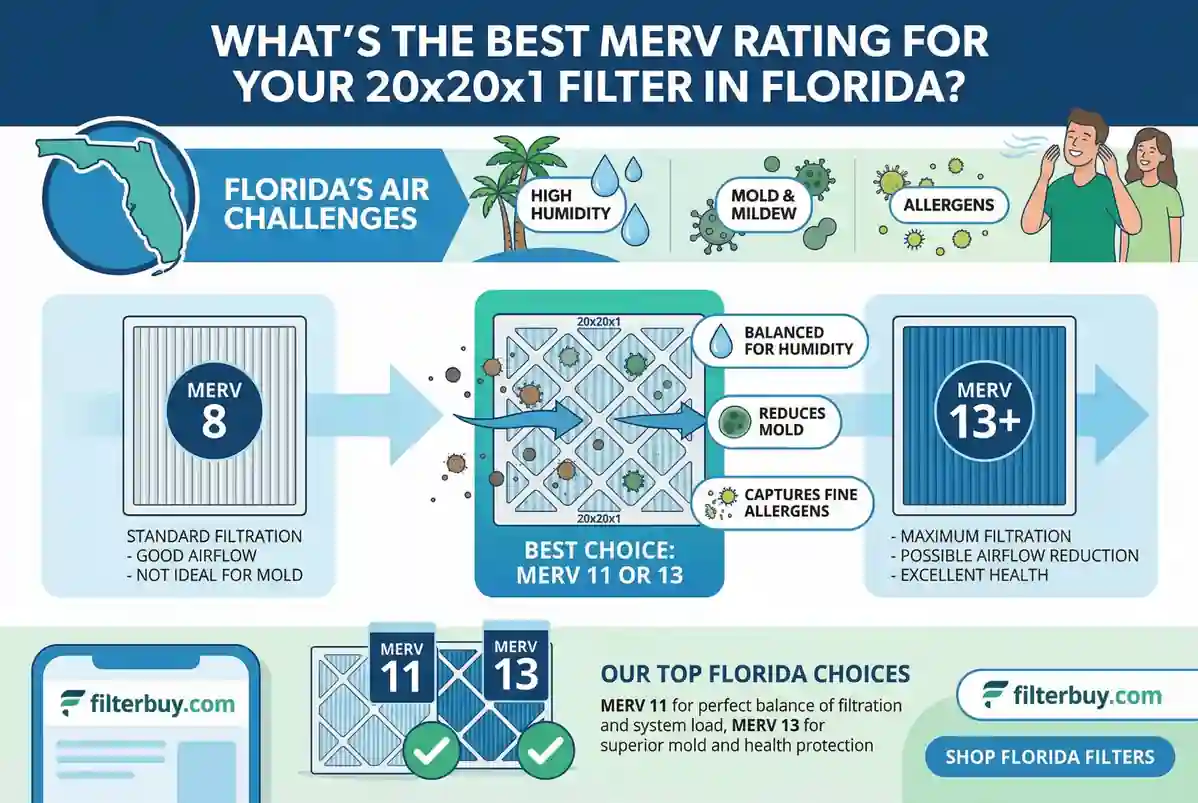
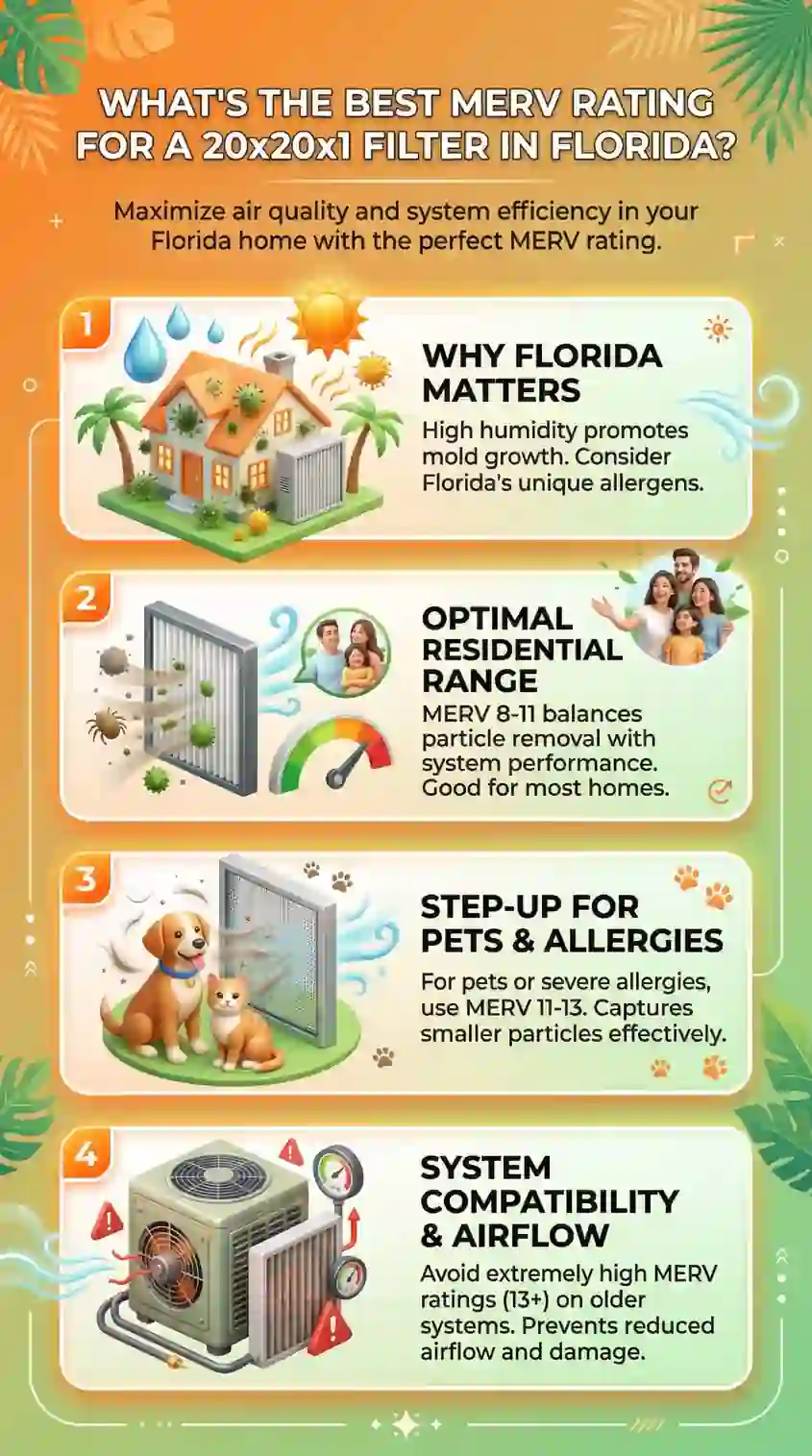
MERV 11 is the right starting point for most Florida homes. It catches mold spores, fine pollen, and particulate matter — without restricting airflow or stressing your HVAC system.
Florida's humidity rewrites the filter change schedule. Saturation happens in 30 to 45 days here — not the 90 days on the label. Plan accordingly.
Your change interval matters as much as your MERV rating. A fresh MERV 11 beats a neglected MERV 13. The rating only works when the filter is actually working.
MERV 13 is right for health-sensitive households — but only with a compatible system. Asthma, severe allergies, compromised immune system? Consider upgrading. Just confirm your blower can handle the added static pressure first.
A saturated filter is an active problem, not just a passive one. It stops filtering. It blocks airflow. It lets indoor pollutant levels — already up to 5 times higher than outdoors — climb unchecked. In Florida, consistent changes aren't optional. They're the whole strategy.
What MERV Ratings Actually Measure
MERV stands for Minimum Efficiency Reporting Value — a standardized scale developed by ASHRAE that rates how effectively a filter captures airborne particles. The scale runs from 1 to 16 for residential and commercial use, with higher numbers capturing smaller particles at greater efficiency.
For a 20x20x1 filter in a standard residential HVAC system, the practical range runs from MERV 8 to MERV 13. Below MERV 8, filtration is too minimal to meaningfully protect indoor air quality. Above MERV 13, the media density creates airflow resistance most residential systems aren't engineered to overcome.
What the rating doesn't tell you is how a filter performs under sustained thermal and humidity stress — and that's exactly where Florida changes the conversation.
Why Florida's Climate Shifts the MERV Decision
Most MERV guidance is written for four-season climates. Florida isn't one. With humidity levels routinely climbing above 70% and AC systems running ten or more months a year, Florida homes face filtration conditions that accelerate everything — particle buildup, mold proliferation, and filter saturation.
Three factors make Florida uniquely demanding on air filters:
Year-round biological load. Florida's warmth and moisture keep mold spores, pollen, and dust mites airborne in concentrations that colder climates only see seasonally.
Compressed change intervals. A filter that lasts 90 days in Minnesota may need replacement in 30 to 45 days in a Florida home. A saturated filter at any MERV level is no longer filtering — it's just blocking airflow.
Continuous system runtime. Florida AC systems don't get the seasonal rest northern systems do. That sustained runtime means more air is pulled through your filter every day, loading it faster and demanding more from your HVAC blower motor.
MERV 8, MERV 11, or MERV 13 — Which Is Right for Your Florida Home?
MERV 8: Adequate Protection, but It Leaves Florida's Biggest Threats Behind
MERV 8 captures larger particles — pet dander, dust, and debris — but its efficiency drops sharply on the sub-3-micron particles that dominate Florida's air quality concerns. Mold spores typically range from 1 to 30 microns. MERV 8 catches the larger end of that range but lets the smaller, more deeply inhaled spores pass through.
For a vacation property or a home with no allergy or asthma concerns, MERV 8 is a functional baseline. For a primary Florida residence, it's working below what the environment actually demands.
MERV 11: The Right Balance for Most Florida Households
MERV 11 captures particles down to 1 micron at roughly 65–79% efficiency — enough to meaningfully reduce mold spores, fine pollen, pet dander, and the fine particulate matter that humid air suspends. Critically, a quality MERV 11 filter achieves this without creating the pressure drop that causes residential blower motors to overwork.
In our experience manufacturing filters for Florida homes, MERV 11 is where most households find the balance point — cleaner air without pushing the system into the efficiency-killing strain that comes from excessive restriction.
MERV 13: Maximum Filtration, but Not for Every System
MERV 13 is the standard recommended for households managing asthma, compromised immune systems, or significant allergy conditions. It captures particles down to 0.3 microns — including fine smoke, bacteria, and most airborne viruses — at 90%+ efficiency.
The tradeoff is real. A MERV 13 filter's tighter media creates measurably higher static pressure. Most residential systems built before 2015 weren't designed with that resistance in mind. Running MERV 13 in an undersized or aging system can reduce airflow enough to cause the evaporator coil to freeze — which stops filtration entirely and risks compressor damage.
If your household has health needs that call for MERV 13, it's worth confirming with an HVAC technician that your system's blower can handle the additional static load before committing to it long-term.
How Often to Change a 20x20x1 Filter in Florida
Filter change intervals matter more in Florida than almost anywhere else. A loaded filter loses efficiency rapidly, and in humid conditions, a saturated filter becomes a surface where mold can establish itself — turning your filter from a protection system into a source.
General guidance for Florida homes:
MERV 8: Every 30–45 days during peak cooling season
MERV 11: Every 45–60 days; more frequently with pets or high occupancy
MERV 13: Every 30–45 days — the denser media loads faster, especially during high-humidity months
These intervals are shorter than what national packaging guidelines typically state, because those guidelines are calibrated for average conditions. Florida isn't average.
When to Adjust Your MERV Rating Up or Down
Your household conditions should drive the final decision as much as the climate does. Consider moving up to MERV 13 if anyone in your home manages asthma, seasonal allergies, or a respiratory condition. Consider staying with MERV 11 — or stepping down to MERV 8 — if you notice reduced airflow, rooms that struggle to cool evenly, or a system that runs longer cycles than it used to.
Those are early signals that your filter is creating more restriction than your system was built to handle. A MERV rating that cleans the air while quietly stressing your equipment isn't protecting your home — it's trading one problem for another.
"Florida homeowners are often surprised to learn that the same MERV 11 filter rated for 90-day use up north needs to come out in 45 days or less down here — sometimes sooner. Humidity doesn't just affect your comfort; it accelerates how quickly a filter loads and dramatically shortens its effective life. After manufacturing filters for over a decade and serving millions of households across the country, we've found that the homes with the worst indoor air quality aren't running the wrong MERV rating — they're running the right one for too long. In Florida, a fresh MERV 11 outperforms a neglected MERV 13 every time."
Essential Resources
Don't take your indoor air for granted — especially in Florida, where what you can't see in your air is exactly what your filter is designed to stop. After manufacturing filters for over a decade and serving more than two million households, we've learned that the homeowners who make the best filter decisions are the ones who understand what's actually at stake. These seven authoritative resources from U.S. government and state health agencies give you that foundation.
1. Start Here: Decode the MERV Scale Before You Buy What Is a MERV Rating? — U.S. Environmental Protection Agency https://www.epa.gov/indoor-air-quality-iaq/what-merv-rating
Most filter shoppers choose by price or brand habit — not by what the rating actually means for their home's air. This EPA resource explains exactly how the MERV scale is tested and what each step up the scale captures. It's the starting point for making a decision you can feel confident about.
2. Make Sure Your HVAC System Can Handle the Filter You Choose Guide to Air Cleaners in the Home — U.S. Environmental Protection Agency https://www.epa.gov/indoor-air-quality-iaq/guide-air-cleaners-home
In our experience, one of the most common mistakes Florida homeowners make is choosing a higher MERV rating without checking whether their system's blower can sustain it. The EPA's residential air cleaner guide walks you through how to match filter efficiency to your system's actual airflow capacity — and when to bring in an HVAC technician before making the upgrade.
3. See the Filtration Standards Federal Programs Require in High-Performance Homes High-MERV Filters: Residential Guide — U.S. Department of Energy, Building America Solution Center https://basc.pnnl.gov/resource-guides/high-merv-filters
ENERGY STAR, EPA Indoor airPLUS, and the DOE's Zero Energy Ready Home program all mandate minimum MERV thresholds — because federal building science has already done the research on what effective residential filtration requires. This resource shows you where those benchmarks land, and gives you a useful baseline for evaluating your current filter.
4. See What's Actually Floating Through Your Home Right Now Indoor Particulate Matter — U.S. Environmental Protection Agency https://www.epa.gov/indoor-air-quality-iaq/indoor-particulate-matter
Here's something most homeowners don't realize: the particles posing the greatest health risk indoors are the ones you can't see. This EPA resource identifies the fine particulate matter — PM2.5 — that circulates through your home every day and explains why intercepting it at the filter level is one of the most impactful things you can do for your family's health.
5. Understand What Happens When Filtration Falls Short Health and Environmental Effects of Particulate Matter — U.S. Environmental Protection Agency https://www.epa.gov/pm-pollution/health-and-environmental-effects-particulate-matter-pm
Particles smaller than 10 micrometers don't stop at your airways — the finest ones can reach the bloodstream. The EPA connects unfiltered airborne particulate directly to cardiovascular and respiratory health outcomes. Reading this puts real weight behind the MERV decision — and makes clear why getting it right matters for everyone under your roof.
6. Know Why Mold Is Florida's Most Persistent Indoor Air Threat Mold and Indoor Air Quality — Florida Department of Health https://www.floridahealth.gov/community-environmental-public-health/environmental-public-health/air-quality/mold/
Most MERV guides are written for climates that get a winter break from mold season. Florida doesn't. The Florida Department of Health explains how the state's heat and humidity create year-round conditions for mold spore proliferation indoors — and why humidity control and proper filtration aren't two separate problems. They're the same one.
7. Access the Florida-Specific Indoor Air Guidance Built for Your Climate Florida Indoor Air Quality Program — Florida Department of Health https://www.floridahealth.gov/environmental-health/indoor-air-quality/index.html
Florida has maintained a dedicated indoor air quality program since the late 1980s — because the state's climate creates conditions that generic national guidance simply doesn't account for. This resource connects you to county-level IAQ contacts, radon information, and state-specific expertise. It's the kind of local context that makes a real difference when you're protecting a Florida home.
These essential resources help you make informed filtration decisions by understanding MERV ratings, system compatibility, and indoor air risks, reinforcing how regularly maintaining AC unit performance works hand in hand with proper filter selection to keep your home's air clean and healthy.
Supporting Statistics
The data on indoor air quality tells a story most homeowners never expect to hear — and one we've seen play out in homes across the country for over a decade.
The air inside your home can be significantly more polluted than the air outside.
The U.S. EPA reports that Americans spend approximately 90% of their time indoors — where pollutant concentrations are often 2 to 5 times higher than outdoor levels. That gap surprised us early in our manufacturing history too. Customer feedback kept pointing indoors as the real problem. It's why we stopped treating air filters as an HVAC accessory and started treating them as a frontline health product.
What that means for your home:
Your return vent filter is doing more work than most homeowners realize
In Florida, it's doing that work around the clock
An under-performing filter doesn't just fall short — it fails silently
Source: U.S. Environmental Protection Agency — Indoor Air Quality https://www.epa.gov/report-environment/indoor-air-quality
Florida is the most humid state in the nation — and humidity is the engine behind indoor mold growth.
NOAA confirms Florida carries the highest sustained humidity burden in the country. The Florida Department of Health sets the mold growth threshold at 60% indoor relative humidity. Here's what that means in practice:
Filter media rated for 90 days in a dry climate saturates in 30 to 45 days in a Florida home
Humidity shortens filter life, feeds mold spore production, and turns a clean-air investment into a blocked vent
Change intervals must be adjusted for the climate you actually live in — not the national average printed on the packaging
Sources: NOAA National Centers for Environmental Information — Florida State Climate Summary https://statesummaries.ncics.org/chapter/fl/
Florida Department of Health — Mold and Indoor Air Quality https://www.floridahealth.gov/community-environmental-public-health/environmental-public-health/air-quality/mold/
Dampness and mold exposure inside the home is directly linked to serious respiratory outcomes.
CDC and NIOSH research links indoor dampness and mold to a documented range of conditions:
Asthma onset and worsening
Bronchitis and recurring respiratory infections
Rhinosinusitis and hypersensitivity pneumonitis
We've heard these outcomes described in customer conversations for years — Florida households with unexplained allergy flare-ups, persistent coughs, or worsening asthma that improve after switching to a higher MERV rating and tightening their change schedule, often alongside noticing a dryer vent cleaning sign that airflow issues extend beyond just the filter. A saturated or under-rated filter isn't a neutral presence in your home. It's an active contributor to the biological load cycling through your air supply.
Getting the MERV rating right — and replacing it on a Florida-appropriate schedule — is one of the most direct steps you can take to protect your family.
Source: CDC / National Institute for Occupational Safety and Health (NIOSH) — Respiratory Disease from Exposures Caused by Dampness https://www.cdc.gov/niosh/docs/2013-102/default.html
Final Thoughts
Most filter guides hand you a rating and move on. After more than a decade of manufacturing filters and shipping them to Florida homes, we've learned that's not enough.
The MERV rating on the box is only half the decision. The other half is understanding what Florida's climate does to that filter once it's installed.
What we've learned that most guides won't tell you:
A MERV 11 chosen with Florida's climate in mind outperforms a MERV 13 chosen without it
Filter change interval is the most underestimated variable in residential air quality
A saturated filter — at any MERV level — stops filtering and starts restricting
In Florida, that saturation cycle can happen in 30 to 45 days
National packaging guidelines aren't written for Florida conditions
Our honest recommendation for most Florida homeowners:
Start with MERV 11 — it captures the mold spores and fine particulate matter Florida generates year-round
Adjust your change schedule to every 45 to 60 days — not the 90 days on the label
Upgrade to MERV 13 only if your household has documented health needs — and verify your system can handle the added static pressure first
Homeowners who upgrade their MERV rating without adjusting their change schedule often end up worse off. A restriction-heavy, overloaded filter strains the blower motor and undermines the very air quality gains they were chasing.
Clean air in a Florida home isn't complicated. But it does require making your decision based on the climate you actually live in — not the national average.
FAQ on 20x20x1 Air Filters
Q: What does 20x20x1 mean on an air filter?
A: It's the filter's dimensions — length, width, and thickness in inches.
What most homeowners miss:
Nominal sizing often runs slightly smaller than the stated dimensions
Always measure your existing filter or slot opening directly
Don't trust the number printed on your old filter's frame
After manufacturing over 600 filter sizes, we've found that direct measurement eliminates the most common sizing mistakes
Q: What MERV rating should I choose for a 20x20x1 filter in Florida?
A: MERV 11 is the right choice for most Florida households.
Here's why:
Florida's humidity keeps mold spores and fine particulate matter airborne year-round
MERV 11 intercepts them without pushing your blower motor into the strain zone
MERV 13 is appropriate for asthma or severe allergy households — but verify system compatibility first
In our experience, more Florida homeowners damage their HVAC systems by over-filtering than by under-filtering
Q: How often should I change a 20x20x1 air filter in Florida?
A: More often than the box says. National 90-day guidelines aren't written for Florida conditions.
Florida-specific change intervals:
MERV 8: Every 30 to 45 days
MERV 11: Every 45 to 60 days
MERV 13: Every 30 to 45 days
Homes with pets or high occupancy: Change at the shorter end of each range
A saturated filter doesn't just underperform. It restricts airflow and can become a surface for mold growth inside your system.
Q: Can a 20x20x1 MERV 13 filter damage my HVAC system?
A: Yes — and it happens more than most homeowners expect.
The risk factors:
MERV 13's denser media creates higher static pressure than most pre-2015 systems were designed to handle
Reduced airflow leads to a frozen evaporator coil
Sustained coil freezing risks long-term compressor damage
How to protect your system:
Check your HVAC manual for maximum static pressure ratings
Have a technician confirm MERV 13 compatibility before switching
When in doubt, a MERV 11 your system can sustain outperforms a MERV 13 that's working against it
Q: Is a 20x20x1 air filter the same as a 20x20x1 furnace filter?
A: Yes — same product, different name.
What stays the same regardless of terminology:
Identical filter media, dimensions, and MERV rating system
Same installation process and slot fit
What changes in Florida specifically:
Florida AC systems run 10 or more months per year
More runtime means more air moves through the filter — faster loading, faster saturation
That sustained demand is exactly why Florida change intervals must be shorter than national guidelines suggest
Find the Best 20x20x1 Air Filter for Your Florida Home
You now know what Florida's climate demands from a 20x20x1 filter — the right MERV rating, the right change schedule, and the right fit for your system. Shop Filterbuy's American-made 20x20x1 air filters in MERV 8, MERV 11, and MERV 13 and get the protection your home's air quality deserves, delivered directly from our factory to your door.