TL;DR Quick Answers
24x24x1 air filter
A 24x24x1 air filter is a 24-inch square, 1-inch deep HVAC filter that drops into a large return grille, common in homes with high ceilings or a single central return. We recommend pleated MERV 11 or MERV 13 versions for households dealing with allergies, pets, or year-round AC use.
Standard dimensions: 24" x 24" x 1" (576 square inches of face area, 1-inch depth).
Best MERV for allergies: MERV 11 as the entry level, MERV 13 for stronger capture if your HVAC system can handle the airflow resistance.
Replacement cadence: Every 60 to 90 days standard, every 30 to 45 days during peak pollen season or in pet homes.
Common location: Large central return grille in homes with high ceilings or open floor plans.
Top Takeaways
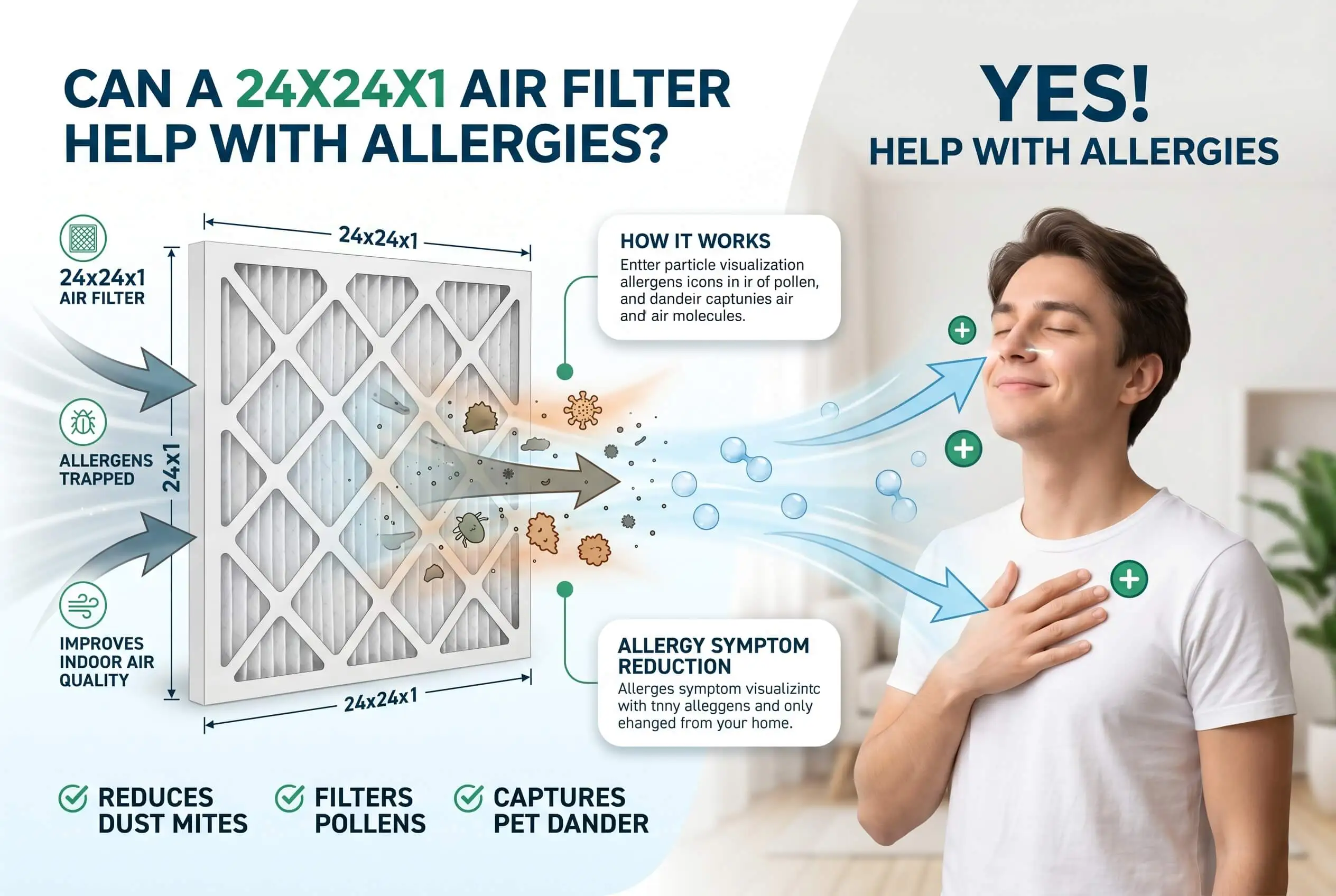
A 24x24x1 filter rated MERV 11 or MERV 13 captures most common airborne allergens, including pollen, mold spores, dust mite debris, and pet dander.
Higher MERV ratings add airflow resistance. Check that your HVAC system can handle the pressure drop before going above MERV 13.
Pleated media with a sturdy frame outperforms flat fiberglass on both capture and durability, particularly in humid climates.
Replace allergy filters every 30 to 45 days during peak pollen season and every 60 to 90 days the rest of the year.
A filter handles airborne allergens only. Pair it with weekly bedding washes and regular vacuuming for the best results.
How a 24x24x1 Air Filter Actually Filters Allergens
The 24x24x1 size fits into a larger return grille, typically the single big return slot you'll find in homes with high ceilings, open floor plans, or a centralized air handler. When the AC kicks on, your blower pulls air from every room toward that return. The filter sits in the path. Pleated media inside catches particles as air moves through. That's how mechanical air filters work in plain terms.
Common household allergens land in a size range a pleated filter handles well:
Pollen grains: 10 to 100 microns.
Mold spores: 1 to 30 microns.
Dust mite allergen particles: 10 to 40 microns.
Pet dander: around 2.5 microns and up.
There's one catch we want every homeowner to understand. The filter only works while the system is running. In Florida, that's rarely a problem because the AC runs almost year-round. In a Northern home where the system sits idle for stretches in spring, the same filter on the wall can let allergen levels climb anyway.
An air filter or a furnace filter is most effective when it captures allergens while they’re still moving through your home’s airflow. With the right fit and MERV rating, it can help reduce airborne particles, support cleaner indoor air, and keep your HVAC system running more smoothly. For allergens already settled into bedding, carpets, or upholstery, pairing regular filter changes with weekly washing and vacuuming gives your home a stronger overall allergy-control routine.
Which MERV Rating Works Best for Allergies in a 24x24x1 Slot
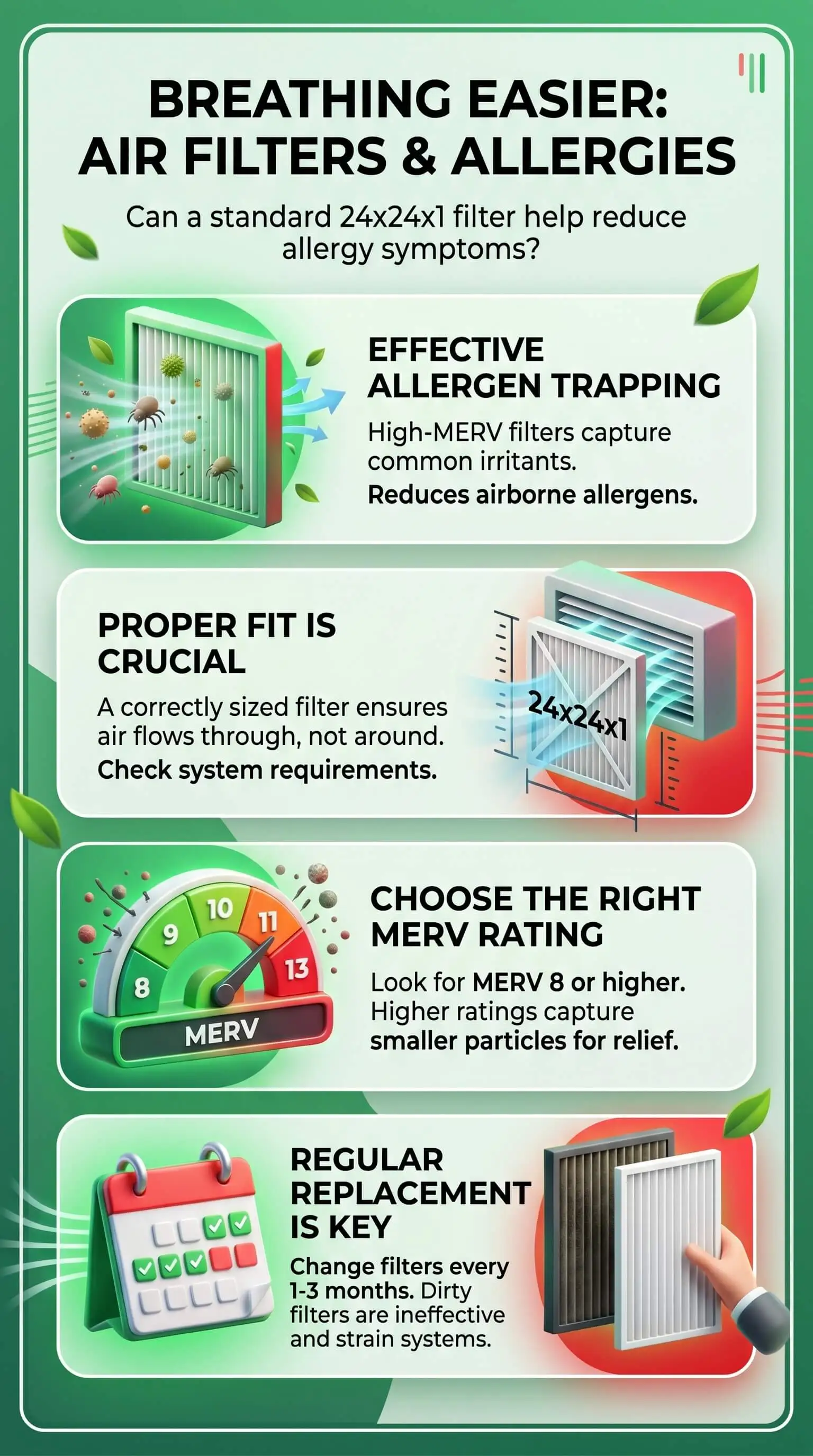
MERV stands for Minimum Efficiency Reporting Value, the ASHRAE-developed scale that tells you what a filter actually captures at common particle sizes. For households dealing with allergies, MERV 11 is our entry-level recommendation. MERV 13 is where most allergy sufferers notice a real change.
Here's the rough capture range mapped to the allergens that matter most:
MERV 8: Pollen, dust mites, and larger pet dander. A baseline filter that protects your equipment more than your lungs.
MERV 11: Most pollen, mold spores, pet dander, and finer household dust. This is where we'd call a filter genuinely allergy-targeted.
MERV 13: Adds capture of smaller particles, including some bacteria and the finest pet dander. This is also the level the EPA recommends for residential systems that can handle it.
Higher MERV always brings a trade-off. Denser pleats mean more resistance for your blower to push air through. Most modern HVAC systems handle MERV 13 just fine. Older units can struggle with the jump, especially the 90s-era air handlers we still see in plenty of South Florida homes. A blower fighting too much resistance will cut cooling output, run longer, and sometimes ice up the evaporator coil.
Before you go past MERV 11, check your equipment manufacturer's spec sheet or have a technician verify the system can handle the additional pressure drop. If it can't, stick with MERV 11. It's still a strong allergy filter, and it won't put your AC at risk.
Choosing the Right 24x24x1 Filter for Your Home
Four things separate a filter that actually does the job from one that just sits in the slot looking the part:
MERV rating matched to your needs. For allergy concerns, MERV 11 or MERV 13. Skip the MERV 4 fiberglass panels — those exist to protect the equipment, not your lungs.
Pleated media over a flat panel. Pleated filters give the air more surface area to pass through, which means better capture without choking off airflow. Flat fiberglass filters can't compete on either front.
A sturdy frame. Cheap cardboard frames warp when humidity climbs, and in South Florida humidity always climbs. Once the frame warps, unfiltered air slips around the media through bypass gaps. Look for a reinforced beverage-board or wire-backed frame.
A manufacturer that publishes its actual capture data. For households dealing with seasonal pollen or pet dander, we usually point homeowners toward a pleated MERV 11 or MERV 13 24x24x1 air filter from a manufacturer that prints test data on the box, not just marketing claims.
The mistake we see most often: a homeowner grabs the highest MERV filter on the shelf without checking anything else. A MERV 16 dropped into a system rated for MERV 8 will hurt the AC and may not even deliver cleaner air, because the bypass at the seams grows as the filter loads up. Match the filter to the slot, the slot to the system, and the system to the actual allergy needs in the home.
How Often to Replace a 24x24x1 Filter When Allergies Are the Concern
The standard 90-day rule comes straight from ENERGY STAR's maintenance guidance, and it's a reasonable default for most homes. For households actively managing allergies, we shorten that cadence.
Here's the schedule we recommend:
Outside of allergy season: every 60 to 90 days.
Peak pollen season in Florida (late February through April runs heavy): every 30 to 45 days.
Homes with two or more pets: every 30 to 45 days year-round.
Homes with smokers: every 30 days.
A 10-second visual check beats any calendar. Pull the filter out, hold it up to a light, and look. If you can't see daylight through the pleats, the filter is spent. A loaded filter doesn't just stop catching new allergens. It strains the blower, drives up your electric bill, and forces more air to slip around the frame instead of through the media.
One Florida-specific point worth making. Central AC in our climate runs most of the year, so our filters do more work than filters in homes with seasonal HVAC use. The 90-day national average doesn't really apply here. Most of the South Florida homes we service run a 60-day cycle, and 30 days during pollen peaks.
“The most common allergy filter mistake I see in the field is the same one over and over. A homeowner grabs the highest MERV number on the shelf without checking whether their blower can actually push air through it. A properly sized MERV 11 in a clean system will outperform a MERV 16 in a system that's now starving for airflow. Match the filter to the equipment first, then to the allergy concern.”
7 Essential Resources
Independent guides for going deeper on filtration, allergies, and indoor air quality.
EPA's Indoor Air Quality (IAQ) hub. The baseline overview of what affects the air inside your home and the three control strategies that actually move the needle.
EPA's Guide to Air Cleaners in the Home. The anchor reference for MERV ratings, HEPA comparisons, and how filtration fits into a broader air quality strategy.
EPA's The Inside Story: A Guide to Indoor Air Quality. A homeowner-friendly walkthrough of pollutant sources and ventilation basics.
AAFA's Control Indoor Allergens to Improve Indoor Air Quality. Practical room-by-room guidance from the Asthma and Allergy Foundation of America.
AAFA's Pollen Allergies overview. Trigger details, seasonal patterns, and steps to limit pollen exposure indoors.
ENERGY STAR's Heating and Cooling Maintenance Checklist. The official monthly-check, three-month-replace baseline for HVAC filters, plus the full preventive maintenance list.
CDC's Diagnosed Allergic Conditions in Adults (NHIS 2021). National Health Interview Survey data on how common seasonal allergies, eczema, and food allergies actually are in U.S. adults.
3 Statistics
About 25.7% of U.S. adults had a diagnosed seasonal allergy in 2021, according to CDC National Health Interview Survey data. Source: CDC NCHS Data Brief 460.
Americans spend about 90% of their time indoors, where pollutant concentrations can be two to five times higher than typical outdoor levels. Source: EPA's Report on the Environment: Indoor Air Quality.
Filters with a MERV between 7 and 13 are likely to be nearly as effective as true HEPA filters at controlling most airborne indoor particles, while allowing the higher airflow most residential HVAC systems require. Source: EPA Guide to Air Cleaners in the Home.
Final Thoughts and Opinion
A 24x24x1 filter is one of the simplest, lowest-cost upgrades a homeowner can make for indoor air quality. It won't end allergy season for your household — nothing in HVAC will — but a properly chosen MERV 11 or MERV 13 filter, changed on a realistic cadence and paired with regular bedding and surface cleaning, measurably lowers the airborne allergen load. The biggest mistake we see is treating this as one decision when it's actually three: the right filter, the right schedule, and a system that can handle the load. Get all three right, and most allergy sufferers in the homes we service feel a noticeable difference within a few weeks.
Frequently Asked Questions
What MERV rating is best for a 24x24x1 air filter if I have allergies?
MERV 11 is the entry point for allergy-targeted filtration, and MERV 13 is the level the EPA recommends for residential systems that can handle it. MERV 11 captures most pollen, mold spores, and pet dander. MERV 13 adds finer particle capture, including some bacteria and the smallest dander pieces.
How often should I change a 24x24x1 air filter during allergy season?
Every 30 to 45 days during peak pollen season, and every 60 to 90 days outside of it, as part of regular maintenance for air conditioning units. Pet households and homes running central AC year-round should stick with the shorter cadence. Hold the filter up to a light. If you can't see through the pleats, it's time to replace it.
Is a HEPA filter better than a high-MERV 24x24x1 air filter for allergies?
True HEPA filters capture more particles, but most residential HVAC systems aren't built to push air through them. A MERV 13 pleated filter sized 24x24x1 captures most household allergens without straining the equipment. A portable HEPA air purifier in a bedroom is a reasonable add-on, not a replacement for HVAC filtration.
Can a 24x24x1 filter alone eliminate allergy symptoms at home?
No. A filter only handles airborne particles while the HVAC system is running. Settled allergens on bedding, carpets, and upholstery need cleaning, vacuuming, and weekly laundry. Think of the filter as one piece of an allergy-control routine, not the whole answer.
Take the Next Step Toward Easier Breathing at Home
Pick the right filter, change it on the schedule your home actually needs, and check that your system can handle the load. That's the formula. Start by measuring your return slot to confirm the 24x24x1 size, then choose a pleated MERV 11 or MERV 13 from a manufacturer that publishes its capture data on the box.