TL;DR Quick Answers
Air Quality Milwaukee
Milwaukee's air quality changes fast, often within a single afternoon. Ground-level ozone drives summer spikes, while wildfire smoke and winter inversions drive particulate spikes. I check a live AQI reading before deciding what the day looks like, and you should too.
Right now: conditions shift hour to hour, especially in summer.
Biggest culprits: ozone and fine particulate matter.
Best move: check a live AQI reading instead of guessing by the sky.
Top Takeaways
Ozone and fine particulate matter are Milwaukee's two primary air quality concerns, and they peak under different conditions.
Summer heat and sunlight drive ozone, while wildfire smoke, cold inversions, and stagnant air near Lake Michigan drive particulate spikes.
Children, older adults, pregnant individuals, and anyone with asthma or heart or respiratory conditions face the highest risk on poor air quality days.
Checking a live AQI reading takes seconds and is far more reliable than judging air quality by how the sky looks.
Milwaukee's air quality has been trending worse in recent state and national air quality reports, not better.
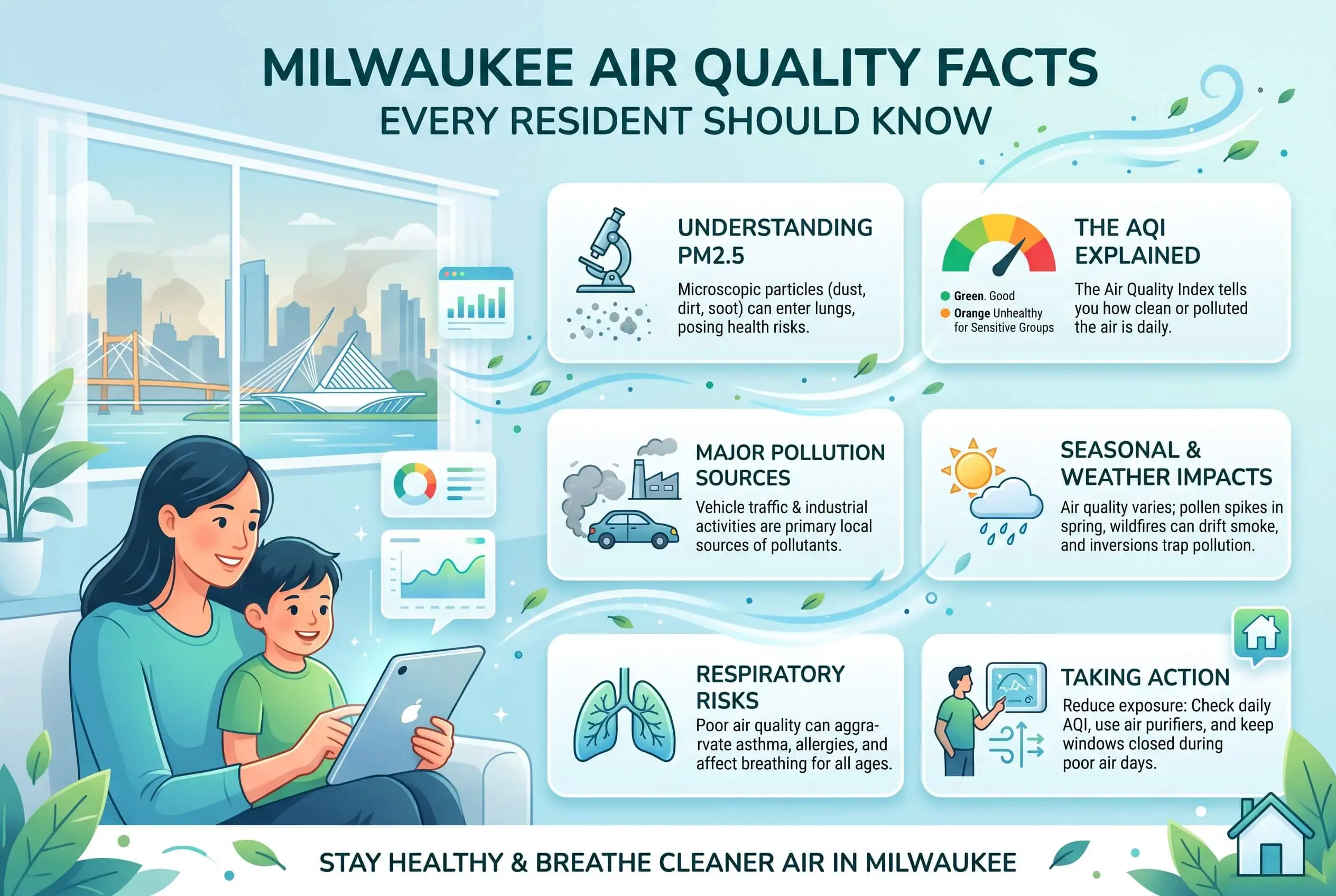
Two pollutants drive Milwaukee's outdoor air quality: ground-level ozone and fine particulate matter. Ozone builds up on hot, sunny summer days when vehicle exhaust and industrial emissions react with sunlight, and it tends to peak in the afternoon and early evening. Particulate matter behaves differently. It comes from vehicle exhaust, wood smoke, and industrial sources, and it can spike sharply during wildfire smoke events, cold-weather inversions, or stretches of stagnant air near Lake Michigan. During these periods, pleated furnace filters can help reduce fine airborne particles that enter your home's HVAC system, supporting cleaner indoor air.
Wisconsin's shoreline location adds its own wrinkle. Weather patterns over Lake Michigan can trap pollution close to the ground during the summer, and Milwaukee has also seen its air quality degrade during Canadian wildfire smoke events that drift south into the Upper Midwest. Winter brings a different problem. Cold air inversions trap smog and exhaust near the surface, which is part of why December and January can post surprisingly elevated readings even without wildfire smoke in the picture. During these periods, regular maintenance for air conditioning units can help keep your HVAC system operating efficiently and support better indoor air circulation.
I don't trust my eyes for this, and neither should you. The only way to know what you're actually dealing with on a given day is to check the live Air Quality Index for your area, not guess based on how the sky looks.
I keep this live Milwaukee AQI map bookmarked for exactly this reason. It's a fast way to see current conditions before deciding whether to send the kids out to play or crank up the air conditioner and keep everyone inside.
Milwaukee (pictured on the map below via Wikipedia) sits directly on Lake Michigan, which is part of why local weather and regional wildfire smoke both play such an outsized role in day-to-day air quality here.
“In my years working HVAC systems around Milwaukee, I notice a clear pattern: every time regional air quality drops into the unhealthy range, my phone starts ringing with filters and indoor air complaints within a day or two.”
7 Essential Resources
Understand How the AQI Communicates Risk
The EPA breaks down exactly how the Air Quality Index translates pollution levels into plain-language health guidance. epa.gov: Communicating Air Quality Conditions.
Get the Basics on Outdoor Air Pollution
The CDC's overview explains what outdoor air quality is, why it matters, and who is most at risk. cdc.gov: About Air Quality.
Check Live Wisconsin Monitoring Data
The Wisconsin DNR's statewide air monitoring dashboard shows current readings from stations across the region. airquality.wi.gov: Air Quality in Wisconsin.
See Milwaukee's Own Air Quality Guidance
The Milwaukee Health Department outlines the AQI color scale, whose most sensitive to poor air, and how to protect yourself locally. city.milwaukee.gov: Outdoor Air Quality.
Follow Local Weather and Air Quality Forecasts
The National Weather Service's Milwaukee/Sullivan office issues forecasts and hazard alerts that often tie directly to air quality conditions. weather.gov: NWS Milwaukee/Sullivan.
Don't Overlook Indoor Air Quality
NIEHS research on indoor air pollutants is a useful reminder that what's happening inside your home matters just as much as what's happening outside. niehs.nih.gov: Indoor Air Quality.
Track Wisconsin's Long-Term Air Quality Data
Wisconsin DHS tracks air quality data over time because of its documented links to asthma, COPD, and heart disease. dhs.wisconsin.gov: Environmental Public Health Tracking.
These trusted resources help you understand Milwaukee's air quality, monitor real-time AQI conditions, follow local forecasts, and protect your health, while reminding you that using a high quality filter can also help improve the air inside your home when outdoor pollution levels are elevated.
3 Statistics
The Milwaukee-Racine-Waukesha metro area ranked 22nd worst in the nation for ozone pollution in the American Lung Association's 2026 State of the Air report. It earned an F grade based on Racine County's average of 10.7 unhealthy ozone days per year over the 2022 to 2024 study period. lung.org: State of the Air, Wisconsin.
On the federal Air Quality Index scale, the EPA classifies any reading above 300 as Hazardous, the highest of its six color-coded categories for outdoor air conditions. See the full scale at airnow.gov: AQI Basics.
NOAA satellite monitoring documented Canadian wildfire smoke degrading surface air quality across the Upper Midwest during the 2025 wildfire season. That's the same regional smoke pattern behind Milwaukee's periodic spikes into hazardous AQI territory. More from nesdis.noaa.gov: Wildfire Smoke and Air Quality.
Final Thoughts and Opinion
After years of working inside Milwaukee homes, my honest take is that most residents check the weather forecast far more often than they check the air quality forecast, and that's backward. A hot, sunny day that looks perfect outside can carry some of the worst ozone readings of the week. I'd rather see people build a quick AQI check into their daily routine the same way they check the temperature, especially if anyone in the house has asthma, a heart condition, or is caring for young kids or older adults. Pairing that habit with MERV 8 pleated HVAC furnace air filters can also help improve indoor air by capturing common airborne particles that enter your home during periods of poorer outdoor air quality.

Frequently Asked Questions
Is Milwaukee's air quality good today?
It depends on the day. Milwaukee's air quality can shift from good to unhealthy within hours, especially during summer ozone season or when wildfire smoke drifts in from Canada. Checking a live AQI reading is the only reliable way to know current conditions.
What causes poor air quality in Milwaukee?
The two biggest drivers are ground-level ozone, which forms on hot, sunny days, and fine particulate matter, which comes from vehicle exhaust, wildfire smoke, and winter air inversions that trap pollution near the ground. During periods of elevated pollution, indoor air quality testing can help determine how outdoor contaminants may be affecting the air inside your home.
Who is most at risk from poor air quality in Milwaukee?
Children, adults over 65, pregnant individuals, and people with asthma, COPD, or heart disease are the most vulnerable groups when the AQI climbs into unhealthy territory.
Does Milwaukee's air quality get worse in the winter?
It can, and I see it every year. Cold air inversions trap smog and exhaust close to the ground, which is part of why winter months sometimes post higher readings than people expect.
Breathe Easier, Starting Today
I built this habit into my own routine, and I think every Milwaukee resident should too.
Milwaukee's air quality can change faster than the weather forecast, so building a quick AQI check into your routine is one of the simplest ways to protect your family. Take a moment to look at current conditions for Milwaukee before your next outdoor plans, and remember that a top HVAC system tune up can also help keep your home's indoor air cleaner and your HVAC system running efficiently during periods of poor outdoor air quality.