Swapping it takes 10 to 20 minutes. You won’t need a single tool on most vehicles, and you’ll keep the $20 to $60 a shop charges in labor.
Here’s what gets me about this job. You already do the exact same thing for your house. You know your furnace filter size without looking it up, you’ve probably got a reminder set on your phone, and you’d never let one run for three years. Learning how to change cabin air filter gives you that same simple sense of control with your car, and once you know where it sits, keeping the air inside your vehicle cleaner becomes an easy part of regular maintenance.
TL;DR Quick Answers
How to Change Cabin Air Filter
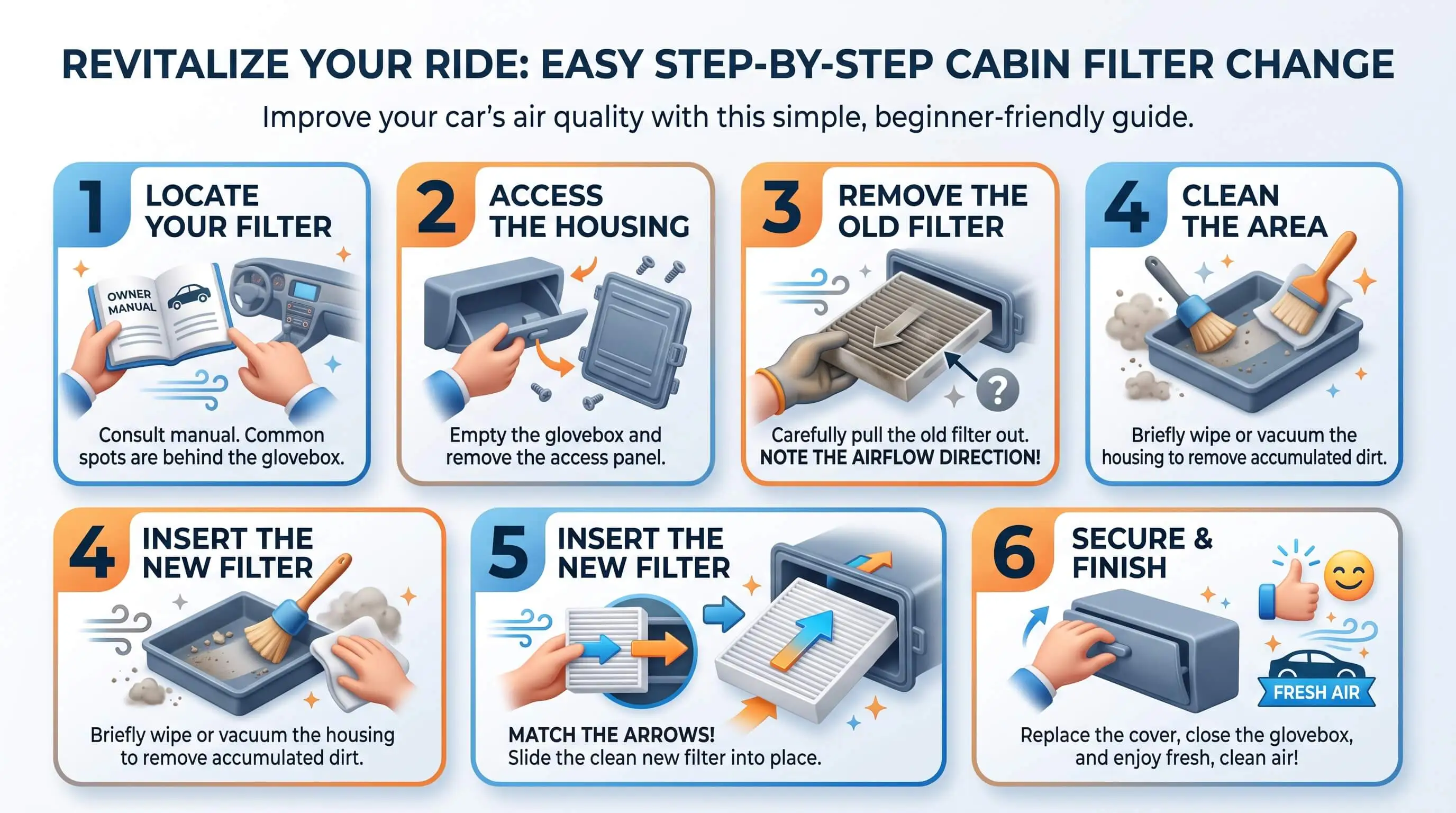
To change a cabin air filter, empty the glove box, release it from its stops, unclip the housing cover behind it, slide the old filter out, seat the new one with its airflow arrow pointing the same direction, then close it all back up. The job takes 10 to 20 minutes and needs no tools on most vehicles.
Empty the glove box and shut the engine off.
Squeeze the glove box sides inward until it drops past its stops.
Unclip the flat housing door sitting behind it.
Read the airflow arrow, then pull the old filter out slowly.
Seat the new filter with its arrow pointing the same way, usually down.
Close the housing, reset the glove box, and run the fan on high.
Wipe out the empty housing before the new filter goes in. Debris left in that cavity gets pulled straight into fresh media, and this is the one filter in your life nobody reminds you about.
Top Takeaways
Most vehicles take 10 to 20 minutes and no tools, and you keep the $20 to $60 a shop bills in labor.
Run the recirculate test before you buy a part. You’re diagnosing a restriction, and it isn’t always the filter.
The airflow arrow is the whole job. Install it backward and your vents move less air than they did before you started.
Wipe out the empty housing while you’ve got access. Debris left in the cavity undoes the new filter.
Cabin filters run on mileage, roughly 12,000 to 30,000 miles, not on the calendar your home filter follows.
Mold, standing water, or an odor that survives a correct replacement all mean it’s time to hand the job over.
What a Cabin Air Filter Does, and How It Differs From the One in Your Furnace
A cabin air filter is a pleated panel sitting in your vehicle’s ventilation intake, catching dust, pollen, soot, and road grit before any of it reaches the vents. Every breath you take while driving passes through it first. It runs on the same principle behind any mechanical air filtration media, where the fibers hold onto particles while the air keeps moving through.
The comparison to your home filter holds up well until it doesn’t. Both use pleated media. Both catch particles as air gets pulled across them. But you buy a furnace filter in nominal inches and choose it by MERV rating, while carmakers spec a cabin filter for one vehicle platform and you look yours up by year, make, and model. Your home filter runs on a calendar. Your car runs on mileage, and that’s why manufacturers write the interval as 12,000 to 30,000 miles rather than a number of days.
The physics inside both boxes is identical. A blower fighting loaded media moves less air and burns more energy doing it. In an air handler you notice weak registers and longer runtimes. In a dashboard you notice vents that barely stir on the highest fan setting.
How to Tell When Yours Actually Needs Changing
Symptom lists are everywhere. A method you can repeat beats a list every time, so here’s the one I use.
Start the car, run the fan wide open, and leave recirculation off. Feel the volume at the center vents. Listen to it, too. Now press recirculate and give it a few seconds. If the airflow jumps when you switch over, you’re watching the system grab an easier path because the outside intake is choked. That points at the filter rather than the blower motor.
Dust is the slower signal. Wipe your dashboard clean, and if a visible film comes back inside a week, material is either passing through the filter or slipping around its edges.
Smell deserves careful separation. A musty odor on startup that fades after a minute usually means loaded media or a damp housing. A sweet, syrupy smell is something else entirely, so don’t spend money on a filter hoping it’ll go away.
What You Need Before You Start
Fitment is the one thing you have to get right. Cabin filters are vehicle-specific, so look yours up by year, make, and model instead of measuring the old one and guessing from the dimensions.
The rest is optional. Gloves keep a season of grime off your hands. A flashlight earns its place, because the space behind a glove box stays dark at noon. Keep a plastic trim tool within reach for the minority of designs that use a clipped panel instead of a hinged door, especially if you want to avoid turning a simple filter change into an HVAC system repair. On most modern vehicles you won’t open a toolbox at all.
How to Change a Cabin Air Filter Step by Step
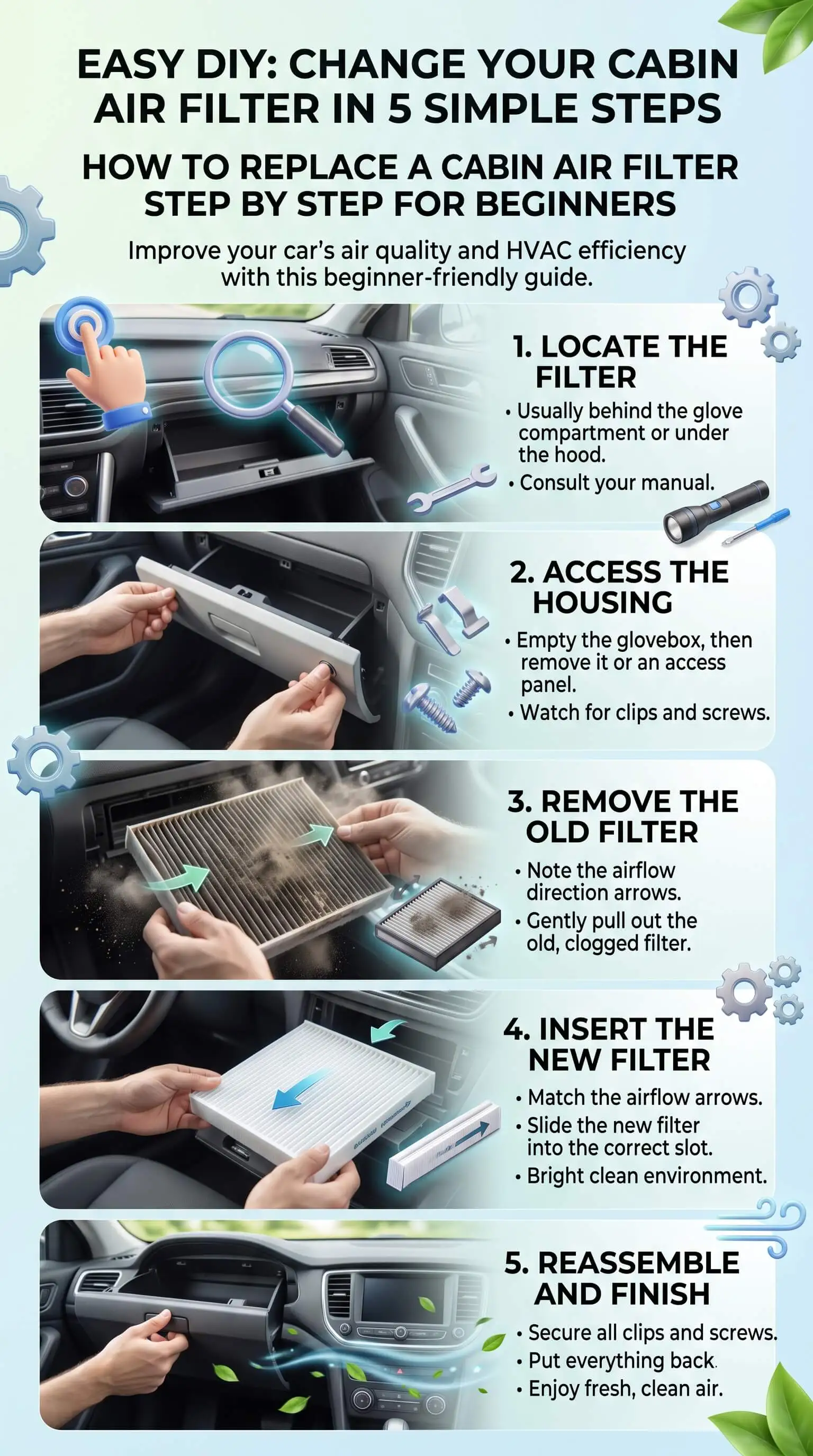
Park on level ground, kill the engine, and empty the glove box. Whatever you leave in there ends up on the floorboard.
Release the glove box so it swings clear of the housing. Most designs use a damper arm on one side plus a pair of flexible tabs. Squeeze the sides gently inward and the box drops past its normal stopping point.
Unclip the housing cover. Behind the glove box you’ll find a flat rectangular door held by one or two tabs. Layouts vary more at this step than anywhere else in the job, so if what you’re looking at doesn’t match that description, a full step-by-step cabin air filter replacement walkthrough covers the designs that hide the housing under the hood near the base of the windshield.
Slide the old filter out, and read the airflow arrow on its frame before it clears the housing. Note which way it points. Pull slowly, because the leaves and grit riding on top of it will drop straight into the blower if you rush.
Seat the new filter with its arrow pointing the same way the old one sat, which on most vehicles means down. This is the step that goes wrong most often. Reverse it and your airflow ends up worse than before you started.
Snap the cover back on, lift the glove box until the tabs click into their tracks, and run the fan on high. You should feel a clear difference at the vents. That’s your finish line.
The Mistakes I See Most Often
The reversed arrow leads by a wide margin. What makes it maddening is that the symptom looks like a failed repair instead of an installation error, so people decide they bought a bad part and go buy a second one.
Second is a filter that doesn’t match the housing. Something close but not correct leaves gaps at the edges, and air takes the open route around the media rather than through it. You get the restriction and none of the filtration.
Third is skipping the empty cavity. If you can see loose debris sitting down there, wipe it out with a dry cloth or touch it lightly with a vacuum. Never spray liquid of any kind into a vehicle air duct.
Fourth is force. Those glove box tabs flex by design. Lever them and they snap clean, usually right when you’ve run out of patience.
Pro Tip: photograph the old filter in the housing before you pull it. Ten seconds now saves you a guessing game about arrow direction later, and it gives you a reference for the next change.
When to Stop and Call Someone
A few situations aren’t worth doing yourself, and I’d rather tell you now than have you find out with the dash half apart. Some vehicles bury the housing behind structures that require pulling the dashboard. That one belongs to a shop.
Find mold growth or standing water inside the housing and you’re looking at a drainage fault, not a filter problem. A new filter soaks through within a month and the smell comes right back.
If a correct replacement doesn’t clear a stubborn odor, the evaporator core is the likely source. It sits deeper in the system and needs proper cleaning from someone with the right equipment.
What a Restricted Filter Does to Your AC System Over Time
The blower motor pays first. Fighting higher static pressure makes it draw more current and shed more heat, and blower motors and their resistors fail earlier under that load.
Airflow across the evaporator matters just as much. The coil needs air moving over it to shed heat, so starving it hands you a cold evaporator and lukewarm air at the vents. That’s the exact complaint that sends people shopping for a refrigerant charge they don’t need.
Moisture is the third consequence. Slower airflow lets condensation sit on the coil longer before it drains, and a damp filter is precisely the environment mold wants.
"The filter is almost never the interesting part. The housing underneath it is where the story lives. I’ve pulled covers where the media still looked serviceable, but the cavity below held a full season of oak catkins packed against the blower opening, and the owner had lived with weak AC for two years because nobody had ever opened that panel. Ten minutes with a dry rag fixed what one shop had already quoted as a blower motor replacement. That’s why I tell people to run the recirculate test before they buy anything. You aren’t diagnosing a filter. You’re diagnosing a restriction, and the restriction isn’t always the part you can order."
7 Essential Resources
Car Care Council, Vehicle Systems Overview puts the cabin filter on the same service interval schedule as everything else you already track. carcare.org/vehicle-systems-overview
ASE Blue Seal shop locator is where to look the moment the job turns into a dashboard removal. ase.com/find-a-repair-shop
NHTSA recall lookup takes your VIN and hands back any open recalls, which is worth five minutes while the glove box already sits empty. nhtsa.gov/recalls
AirNow Air Quality Index basics explains the daily numbers that tell you when recirculation beats fresh air on your commute. airnow.gov/aqi/aqi-basics
American Lung Association clean air guidance covers what fine particles actually do once they reach your lungs. lung.org/clean-air
Asthma and Allergy Foundation of America publishes patient-facing material on controlling allergen exposure, including inside a vehicle. aafa.org
AAAAI National Allergy Bureau pollen counts come from certified counting stations, so you can time a filter change to your local season instead of guessing at it. pollen.aaaai.org
3 Statistics
Health Canada researchers ran a randomized, double-blind crossover study on 48 commuters and found that cabin air filtration cut in-vehicle ultrafine particles by 28 percent, PM2.5 by 30 percent, and black carbon by 32 percent against a placebo filter. National Institutes of Health, PubMed Central
Across twelve passenger vehicles tested while stationary, on local roads, and on freeways, the in-use factory cabin filters averaged 29 percent reduction for PM2.5 and 31 percent for black carbon, while high-efficiency prototypes reached 90 percent for ultrafine particles. California Air Resources Board
More than 45 million people in the United States live within 300 feet of a major road or transportation facility, which is the exposure setting most daily commutes run straight through. U.S. Environmental Protection Agency
Research shows that cabin air filtration can meaningfully reduce PM2.5, ultrafine particles, and black carbon during everyday driving, making top air filters especially valuable for commuters who spend time near busy roads and other high-traffic areas.
Final Thoughts and Opinion
My honest opinion is that this job gets undersold and oversold at the same time. It’s undersold as maintenance, because people who’d never let a furnace filter go three years will happily drive on the factory cabin filter until they trade the car in. It’s oversold as a cure, because a filter won’t fix a drainage fault, a dying blower, or an evaporator that needs cleaning, and plenty of people buy one hoping it will.
What changed my thinking was noticing how often the housing mattered more than the media. The research backs the modest claim, not the dramatic one. A working cabin filter cuts your particulate exposure by roughly a third. That’s real, and it’s worth having, and it still isn’t clean air. The bigger effect comes from pairing a correctly fitted filter with recirculation on the high-traffic stretches of your daily route.
You’re the one looking out for everybody who rides in that car. Treat this as the cheapest 15 minutes of protection available to you, and treat any claim beyond that with the skepticism it has earned.
Where is the cabin air filter located in most cars?
On most modern vehicles it sits directly behind the glove box, and you reach it by releasing the box and dropping it past its normal stop. A smaller number of designs put it under the hood near the base of the windshield. A few hide it beneath the dashboard on the passenger side.
How much does a shop charge to change a cabin air filter?
Labor typically runs $20 to $60 on top of the part for a standard glove box design, and dealerships usually quote higher. Vehicles that need dashboard removal cost considerably more, which is the one case where paying someone makes good sense.
What is the difference between a cabin air filter and an engine air filter?
The cabin filter cleans the air reaching you through the vents. The engine air filter cleans the air heading into the intake for combustion. They sit in different places, use different media, and follow separate intervals, so changing one does nothing for the other.
Can you clean and reuse a cabin air filter instead of replacing it?
Not with a standard pleated filter. Tapping out loose debris buys you a little time, but washing one destroys the electrostatic charge that captures fine particles and leaves damp media sitting in your ventilation system. A few manufacturers sell washable versions, and those are the only ones built for it.
Does a cabin air filter actually help with pollen and allergies?
It helps measurably, within limits. Testing on in-use filters shows particulate reductions around a third, which matters for pollen and road dust without eliminating either. Running recirculate through high-pollen stretches gets you more benefit than the filter delivers on its own.
Ready to Get Started
Go sit in your passenger seat and empty the glove box. One minute in, you’ll know whether this is a job you finish before dinner or one you hand to a shop.
Once it’s done, set a mileage reminder while the number is still fresh, not a date reminder. That single habit keeps this from turning into the three-year-old filter I described at the top.
hen tell me in the comments what you pulled out of yours. I’m always curious what people find down there, whether it looks lightly used or as loaded as MERV 8 pleated HVAC furnace air filters after a long stretch of filtering dust, and your answer helps the next reader know what to expect from their own car.