Pull the filter out of your air handler in late April and you can often see allergy season before you feel it. A thin yellow-green film coats the pleats, and that's pollen your system has been moving through the house for weeks.
The fix takes about two minutes. Slide a fresh 20x25x2 air filter into the cabinet roughly two weeks before your local pollen season starts, then swap it about every 45 days until the first frost. Get that timing right and the filter keeps catching pollen instead of choking on it, which is a small habit with a big payoff for the air your family breathes.
TL;DR Quick Answers
20x25x2 air filter
A 20x25x2 air filter is a two-inch pleated HVAC filter with an actual size of 19½" x 24 1⁄2" x 1¾". It usually sits in the air handler cabinet and works as both your furnace and AC filter. Replace it every 90 days, or about every 45 days during pollen season.
Actual size: 19½" x 24½" x 1¾", cut slightly smaller so it slides into the track and seals.
Where it goes: The two-inch slot in your air handler cabinet, usually not behind a wall grille.
Standard schedule: Every 90 days, with a quick light test each month.
Allergy season timing: Put in a fresh one two weeks before pollen starts, then swap it every 45 days until the first frost.
Best rating for allergies: MERV 11 for most homes, MERV 13 if your system manual allows it.
Don’t mix depths: A 1-inch filter in a 2-inch slot leaves a gap that lets unfiltered air slip past.
Top Takeaways
Put a fresh 20x25x2 filter in about two weeks before your local pollen season starts.
Swap it roughly every 45 days through peak weeks, then go back to every 90 days after the first frost.
Tree, grass, and ragweed seasons overlap, and they're arriving earlier than they did a few decades ago.
MERV 11 suits most allergy households. Step up to MERV 13 only if your system manual allows it.
Skip washing pleated filters, and never put a 1-inch filter in a 2-inch slot.
Why a 20x25x2 Filter Needs Extra Attention in Pollen Season
A 20x25x2 is a two-inch pleated filter with an actual cut of 19½" x 24½" x 1¾". That slightly smaller size lets it slide into the track and seal. Most two-inch filters sit in a cabinet at the air handler, tucked away in a garage or hall closet, so they're easy to forget for months.
The extra inch of depth gives you more pleated media and more room to hold debris before airflow drops. That helps. What it can't do is soak up a heavy pollen month without loading up. Each time your system kicks on, air moves through the media and grains lodge in the fibers, which is how pleated air filters trap airborne particles. A 20x25x2 air filter has more surface area to collect pollen than a typical 1-inch filter of the same length and width, but that extra capacity doesn't make it immune to heavy buildup. On high-count days, your filter fills faster than you'd expect.
When Allergy Season Starts and Peaks
Allergy season actually runs in overlapping waves, making high quality filters essential for managing airborne allergens, and the Asthma and Allergy Foundation of America's 2026 Allergy Capitals report maps out all of them.
Tree Pollen: February Through April
Trees usually start releasing pollen in early to mid-February and keep going through April. If you live somewhere warm, expect an earlier start.
Grass Pollen: Mid-April Through Summer
Grass ramps up in mid-April and carries on through most of summer, so late April and May often hit you with trees and grass at once.
Ragweed: Late Summer Until the First Frost
Ragweed used to peak between mid-August and September. The American Academy of Allergy, Asthma & Immunology now reports that it starts in early August across much of the country and hangs on through October. One plant can release up to a billion grains.
The calendar keeps shifting, too. A 2021 PNAS study of 60 North American pollen stations found seasons starting about 20 days earlier than they did in 1990. A filter change you've always scheduled for "sometime in spring" may now land weeks too late.
A Simple Replacement Timeline for Allergy Season
Two weeks before your season starts. Think back to the week your sneezing usually begins, count back two weeks, and put in a fresh filter. It'll be clean and ready when the first high-count days roll in.
About every 45 days through peak weeks. That works out to roughly every six weeks, a good fit for homes with allergies or asthma. Pets or a system that runs around the clock may call for a shorter interval.
After the first frost. Once ragweed fades, swap the filter one more time so leftover fall pollen doesn't ride along into the heating season. Then go back to a 90-day rhythm.
Signs Your 20x25x2 Filter Needs Changing Now
Your filter usually tells you it's done before the calendar does. Watch for these:
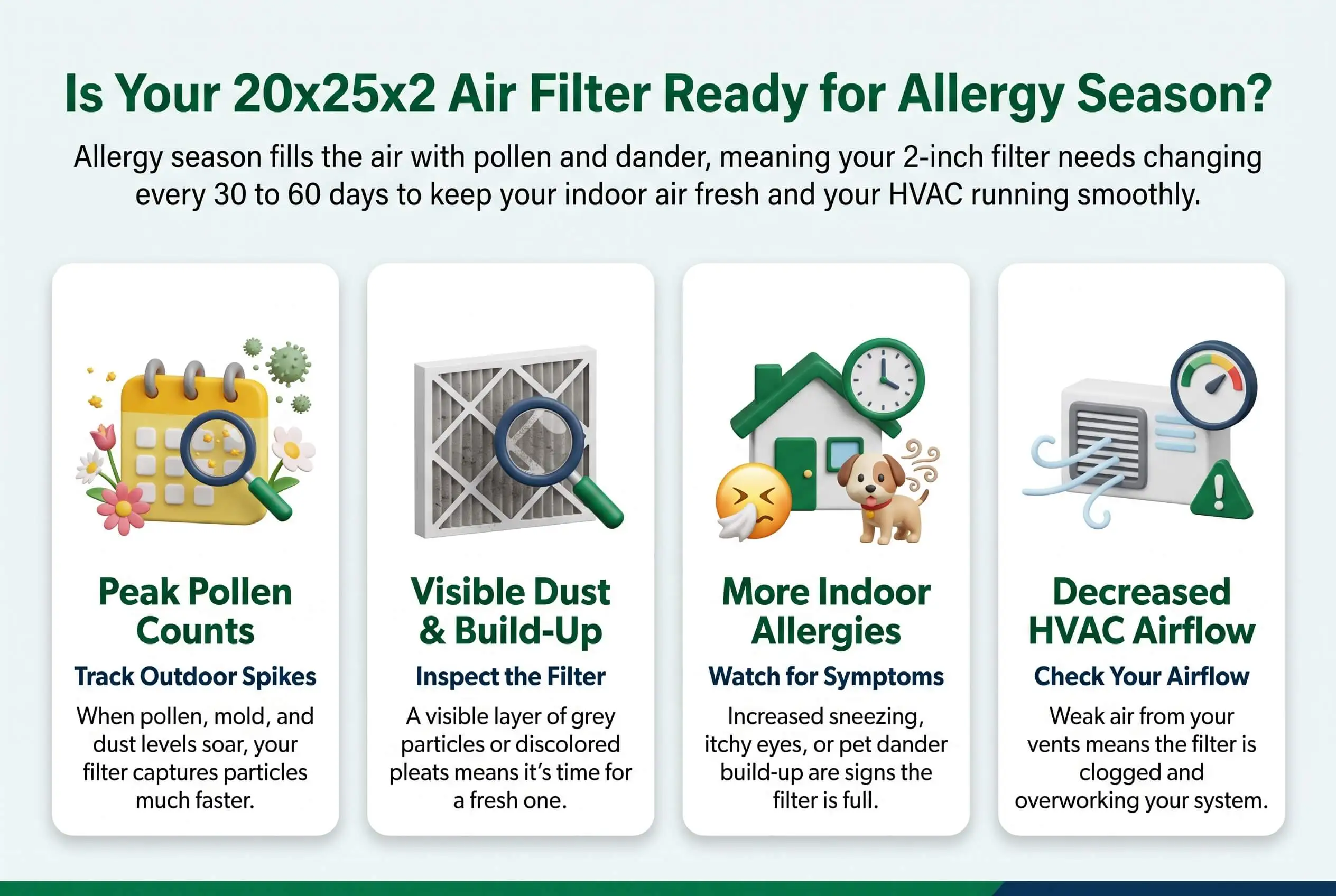
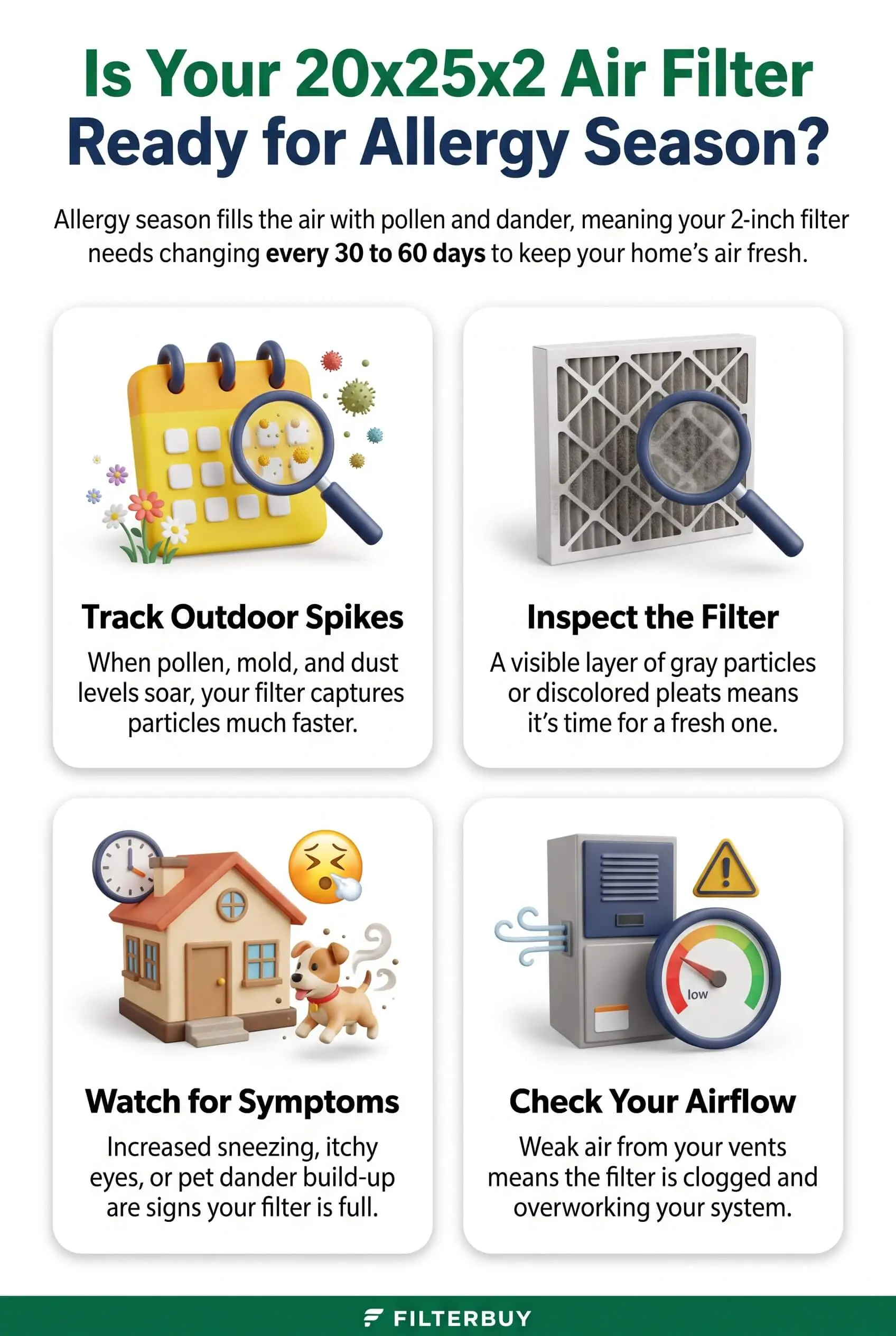
Light won't pass through. Hold the filter up to a bright window. If you can barely see light through the pleats, replace it.
The pleats have turned yellow-green or gray. That's pollen and dust you can finally see.
Dust settles faster near your supply vents. A loaded filter lets more debris slip around its edges and out into the rooms you actually live in.
Your symptoms flare indoors on low-pollen days. Home should feel easier to breathe in than the backyard.
Your system runs longer to reach the same temperature. Restricted airflow makes the blower work harder for every degree.
Picking the Right MERV Rating for Allergy Relief
MERV 11 fits most allergy households. It catches pollen, mold spores, pet dander, and dust mite debris without putting much extra strain on your blower. The American College of Allergy, Asthma and Immunology recommends disposable filters rated MERV 11 to 13 for people managing allergies. MERV 13 traps finer particles as well. It also adds airflow resistance, so check your system manual before you step up. This MERV 13 breakdown walks through that trade-off, and this guide to allergy filters by particle size shows what each rating catches.
Allergy Season Mistakes That Undo a Fresh Filter
Washing a pleated filter. Water strips away the electrostatic charge that helps the media grab fine particles, and you can't put that charge back.
Putting a 1-inch filter in a 2-inch track. Air takes the easy route around the gap instead of through the media.
Stretching the interval because the filter is thicker. Extra depth buys you capacity, but pollen season still sets the schedule.
Forgetting about a second filter. Some homes have one at a return grille and another at the air handler, and both need changing.
Running the fan nonstop without checking more often. Constant circulation filters more air and loads the filter faster in the process.
"In my experience, a two-inch filter pulled in late April almost always looks worse than the calendar says it should. Tree pollen grains are large, so they mat across the face of the pleats instead of working deep into the media. Once that surface layer forms, airflow drops well before the filter looks full from the side."
7 Essential Resources
These independent sources can help you plan around pollen and keep your filter changes on track.
AAFA: Sneezing Season Is Here. Maps out when tree, grass, and ragweed seasons typically run in 2026.
AAAAI: Ragweed Allergy. Explains how ragweed season has stretched later into fall and why its pollen floats so easily.
ACAAI: Air Filters. Allergist advice on choosing and replacing whole-home filters.
Allergy & Asthma Network: Pollen Allergy. Covers pollen seasons, daily pollen patterns, and practical ways to limit exposure.
EPA: Guide to Air Cleaners in the Home. Shows how furnace and HVAC filters fit into a whole-home clean air plan.
ENERGY STAR: Maintenance Checklist. Recommends a monthly filter check and explains how a dirty filter drives up energy costs.
MedlinePlus: Hay Fever. A plain-language overview of pollen allergy symptoms and treatment options.
These independent resources explain how seasonal pollen affects indoor air quality, why timely filter replacements matter, and how regular maintenance for air conditioning units helps control allergen buildup, maintain airflow, and keep HVAC systems running efficiently.
3 Statistics
North American pollen seasons now start about 20 days earlier and carry about 21% more pollen than they did in 1990. Source: PNAS.
More than 90% of U.S. homes had three or more detectable allergens, and 73% had at least one at elevated levels. Source: NIEHS.
About 25.7% of U.S. adults had a diagnosed seasonal allergy in 2021. Source: CDC National Center for Health Statistics.
With North American pollen seasons starting 20 days earlier and producing 21% more pollen, allergens detected in over 90% of U.S. homes, and 25.7% of adults reporting seasonal allergies, choosing the best air filters for your HVAC system matters more than ever, especially when heavy pollen buildup can shorten the effective life of a 20x25x2 air filter.
Final Thoughts and Opinion
I'll be blunt. The standard 90-day reminder lets allergy households down. It treats January and late April like the same month, and any pollen count will tell you they aren't. A 20x25x2 is a well-built filter, but it can only work with the timing you give it.
Tie your changes to your own pollen calendar. Put the first one in before symptoms show up, then check the filter every month through peak weeks. That one shift turns a forgettable chore into the easiest way you have to protect your family, your home, and your HVAC system all season long.
Frequently Asked Questions
How often should I change a 20x25x2 air filter if I have allergies?
Plan on about every 45 days during pollen season and every 90 days the rest of the year. Pets, asthma, or a system that runs constantly may justify the shorter interval year-round. A quick monthly light test is the easiest way to confirm the schedule fits your home.
Should I replace my air filter before or after allergy season?
Both, ideally. A fresh filter two weeks before your pollen season starts is clean and ready when counts climb. One more change after the first frost clears out fall ragweed so it doesn't circulate all winter. This filter change schedule guide covers the rest of the year.
Does a 2-inch filter last longer than a 1-inch filter during pollen season?
Usually, yes. More pleated media means a 2-inch filter holds more debris and loads more slowly. Heavy pollen weeks still fill it faster than normal, though, so treat the extra depth as a cushion and keep your scheduled change during peak season.
What MERV rating works best in a 20x25x2 filter for pollen?
MERV 11 captures most pollen, mold spores, and pet dander and works in nearly any home system. MERV 13 catches finer particles but adds airflow resistance. Check your system manual, or ask an HVAC technician, before you go above MERV 11.
Can I wash and reuse a 20x25x2 air filter?
No. Disposable pleated filters rely on an electrostatic charge to grab fine particles, and water removes that charge for good. A rinsed filter may look cleaner, but it won't perform like a new one. Allergists point out that even permanent filters are hard to clean well enough to help.
Is a 20x25x2 air filter actually 20 x 25 x 2 inches?
Not quite. The 20x25x2 label is the nominal size. The actual cut runs about 19½" x 24 1⁄2" x 1¾", slightly smaller so the filter slides into the track and seals properly. Order by the nominal size printed on your current filter frame.
Breathe Easier This Allergy Season
Grab your calendar, find the week your sneezing usually starts, and mark a filter change two weeks before it. Add a 45-day reminder through peak season, and your 20x25x2 filter will keep catching pollen right up to the first frost.