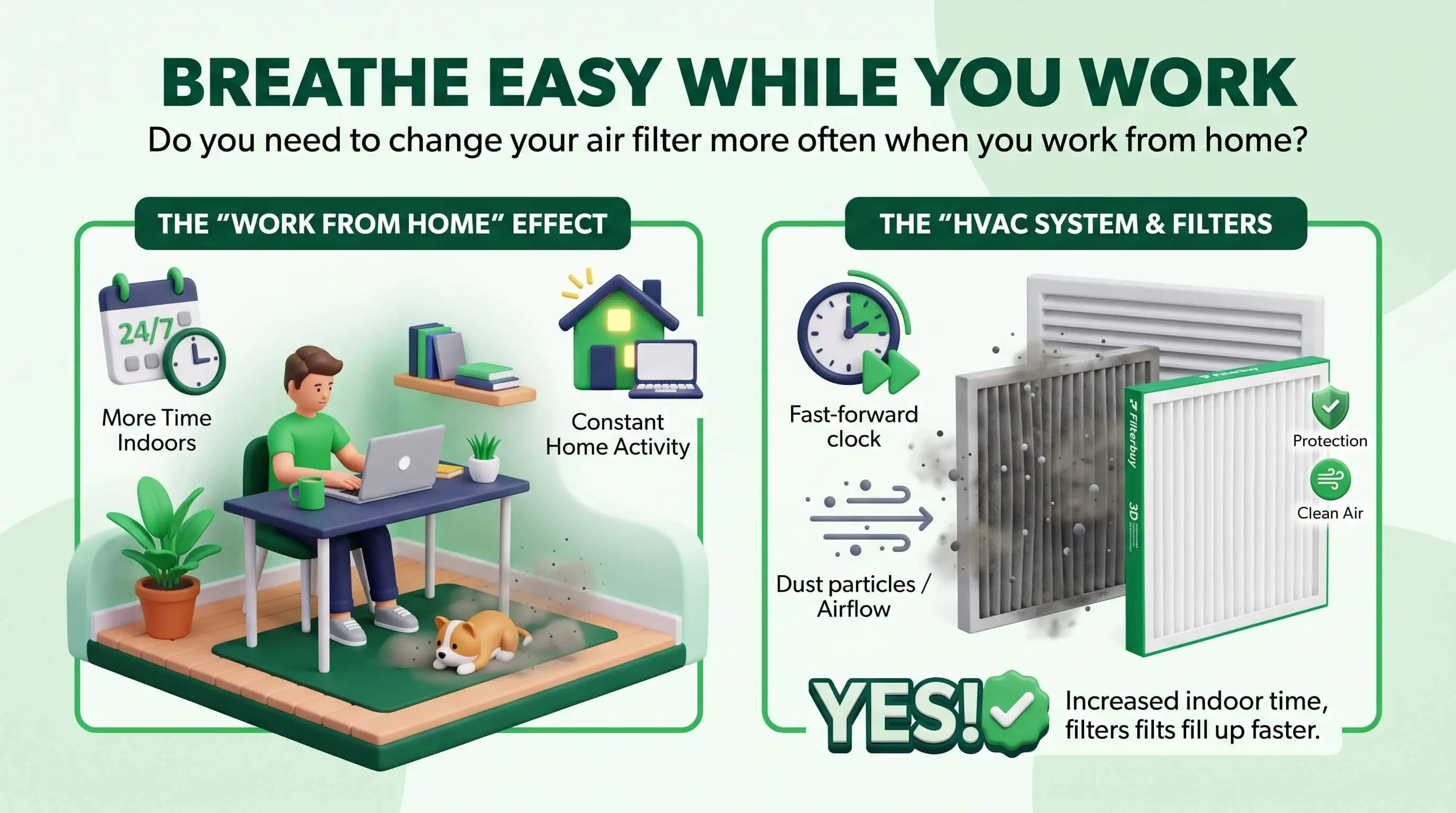
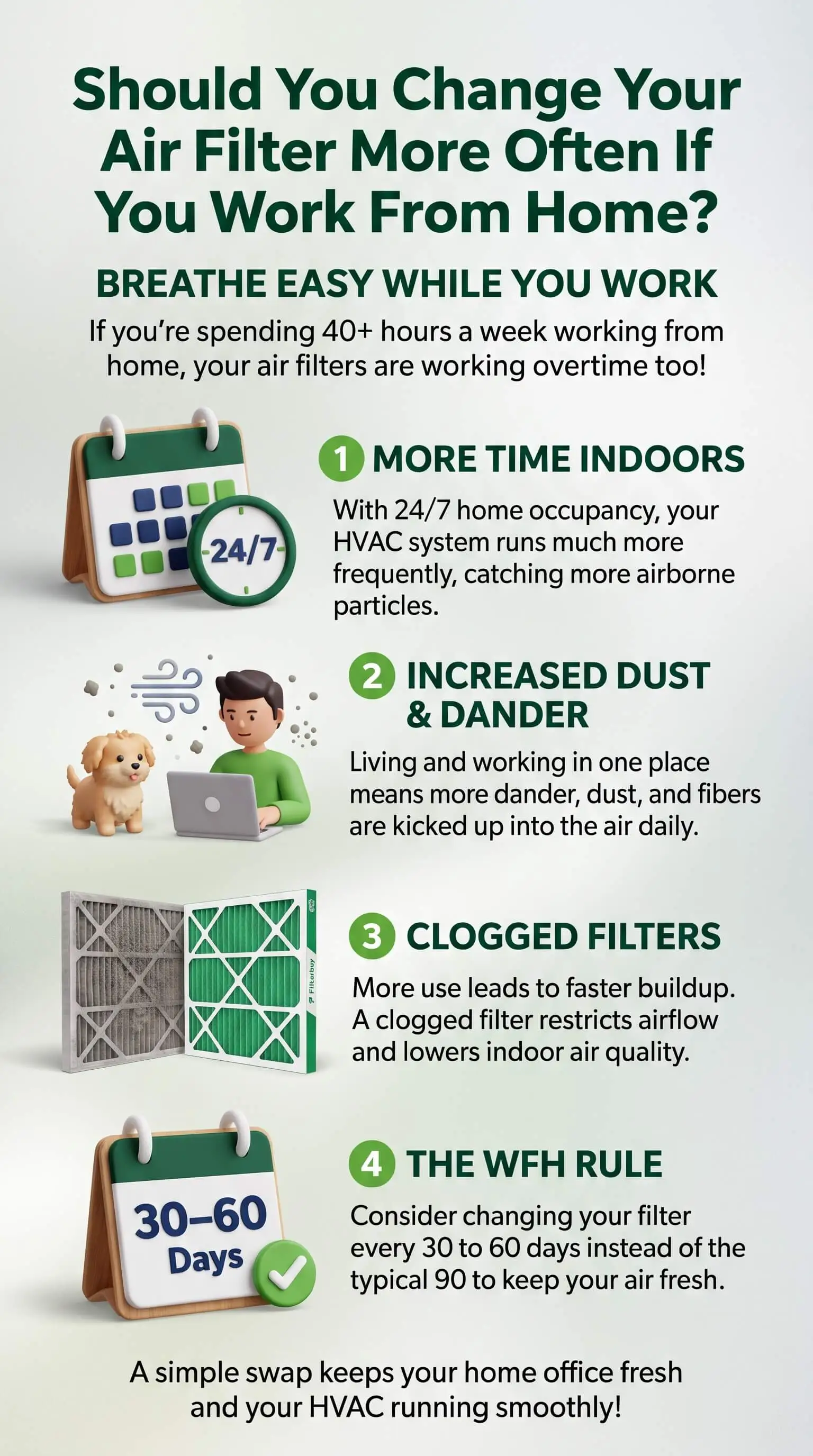
Yes, and probably sooner than you'd guess. Once your house goes from empty all day to occupied all day, your filter starts catching a full shift of dust, skin flakes, cooking particles, and dander it never used to see. Check it monthly, and plan on replacing a standard 1-inch filter every 30 to 60 days instead of 90.
I noticed the shift in my own home. The thermostat used to coast from about eight to six on weekdays while the blower sat quiet. Now there's a laptop on the kitchen table, lunch on the stove at noon, and a system holding steady through hours it used to skip.
A filter doesn't wear out on a calendar, even though most packaging suggests it does. House air filters fill up based on how much air moves through them and how much is floating in that air. Working from home raises both.
TL;DR Quick Answers
air filter replacement
Air filter replacement means swapping your HVAC system’s used filter for a clean one of the exact same size, usually every 1 to 3 months. Check it monthly and replace it sooner when the media looks gray, airflow weakens, or the house stays occupied all day, since more people and runtime fill filters faster.
Standard 1-inch filters: every 60 to 90 days in a lightly used home, and every 30 to 60 days when someone works from home.
Pets, allergies, or smoke days: about every 30 days, and right away after wildfire smoke or a dusty home project.
4-inch and 5-inch media filters: often six months or longer, but still worth a monthly look.
Size and fit: match the nominal size printed on the old frame, depth included, and point the airflow arrow toward the blower.
The payoff: a clean filter can cut air conditioner energy use by 5 to 15 percent, according to the U.S. Department of Energy.
Top Takeaways
Change it more often: daytime occupancy and extra HVAC runtime fill filters faster in work-from-home households.
Look every month: inspect the filter monthly and replace it at least every 3 months, sooner when it looks dirty.
Plan on 30 to 60 days: that range fits most 1-inch filters in remote-work homes, and pets or allergies push you toward 30.
Higher MERV means a shorter window: finer filters capture more but load faster, so tighten your checks after an upgrade.
Make it automatic: tie the check to your work calendar and keep correctly sized spares on hand.
Why Working From Home Changes Your Air Filter Math
Every hour someone spends at home adds to the load. People shed skin cells and track in outdoor dust. Lunch on the stove sends cooking particles toward the return, laptops and printers stir up fine debris, and pets stay active and shedding when they've got company all day.
Your system works harder too. A setback thermostat that once let the house drift until evening now holds a steady setpoint for your home office, so the blower pulls air through the filter during hours it used to rest.
You've got plenty of company in this. About a third of employed Americans did some or all of their work at home on workdays in 2025.
How Often Should You Change Your Air Filter When You Work From Home?
The baseline is simple. Check your filter every month and replace it at least every three months, then adjust for the way your household actually lives. These ranges assume a standard 1-inch pleated filter.
One Remote Worker, No Pets
Plan on about 60 days and take a quick look at day 30. One person adds less load, but daytime runtime still cuts into that 90-day estimate.
Two or More People Home All Day, or Pets
Aim for 30 to 45 days. Two remote workers, a hybrid schedule with kids home after school, or a shedding dog will all pull you toward the short end.
Allergies, Asthma, or Smoke Days
Plan for 30 days. If wildfire smoke drifts in or a dusty home project wraps up, swap the filter right away, even when the calendar says it has time left.
Thicker Filters
A 4-inch or 5-inch media filter holds far more than a 1-inch one and often lasts six months or longer. Follow the manufacturer's range but keep the monthly check, because a full house shortens these too.
Signs Your Filter Is Filling Up Faster Than Before
Your filter usually tells you it's done before the calendar does. Here's what to watch for:
Color: the media looks gray or matted instead of white or off-white.
Airflow: registers push less air, or the rooms farthest from the air handler start lagging behind.
Dust: your desk, monitor, and bookshelves need wiping more often than they used to.
Run time: the system runs longer to reach the same setpoint.
Energy bills: a clogged filter makes the blower work harder, and swapping in a clean one can noticeably trim AC energy use.
Does a Home Office Need a Higher MERV Rating?
Not always, and moving up comes with a tradeoff. MERV stands for Minimum Efficiency Reporting Value, a rating for how well a filter captures particles of different sizes. A MERV 8 pleated air filter handles everyday dust and pollen. MERV 11 grabs finer particles, including more pet dander, and MERV 13 reaches smaller particles still, including much of the fine material in smoke.
Finer media catches more, so it also loads faster and can restrict airflow sooner. If you upgrade while working from home, pair the new filter with monthly checks and a shorter replacement window. Confirm your system can handle the added resistance first, especially with an older blower.
How to Build an Air Filter Replacement Routine That Fits Your Workday
The best schedule is one you don't have to remember. A few habits make it automatic:
Add a recurring monthly reminder to your work calendar, right next to your other first-of-the-month tasks.
Write the install date on the filter frame with a marker.
Keep spares in the correct size on hand so a dirty filter never waits on a store run.
Consider an auto-delivery plan that ships filters on the interval you choose.
Multi-packs keep the cost per filter down and take the guesswork out of the next swap. When you shop for air filter replacement, match the exact nominal size printed on your current filter's frame, depth included. You're the one keeping this house breathing easy, and this routine makes that job a two-minute task.
"In my experience servicing homes where someone works remotely, the filter loads fastest in summer and winter, when the blower runs straight through the workday. The center of the media goes gray first because that's where air moves fastest, and that dense patch cuts airflow long before the edges look dirty. So I tell remote workers to judge the darkest spot, not the average."
Essential Resources
ENERGY STAR Maintenance Checklist: the once-a-month rule to inspect, clean, or change filters in central AC, furnace, and heat pump systems.
Building America Solution Center: High-MERV Filters: high MERV ratings, pressure drop, and filter depth affect your system, and when to replace sooner.
AirNow: When Smoke Is in the Air: the HVAC settings and filter steps to use on smoky days.
American Lung Association: Clean Air Indoors: where indoor pollutants come from and practical ways to cut them.
Asthma and Allergy Foundation of America: Healthier Home: a room-by-room checklist that includes HVAC filter care.
American College of Allergy, Asthma and Immunology: Air Filters: allergist guidance on MERV 11 to 13 disposable filters for whole-house filtration.
CDC Stacks: Indoor Air Filtration Fact Sheet: a multi-agency fact sheet on filtering indoor air during smoke events.
Supporting Statistics
About 90 percent indoors: Americans spend roughly 90 percent of their time indoors, where some pollutant concentrations run 2 to 5 times higher than typical outdoor levels. (EPA Report on the Environment)
35 percent working from home: In 2025, 35 percent of employed people did some or all of their work at home on days they worked. (U.S. Bureau of Labor Statistics, American Time Use Survey)
5 to 15 percent energy savings: Swapping a dirty, clogged filter for a clean one can lower an air conditioner's energy use by 5 to 15 percent. (U.S. Department of Energy, Energy Saver)
With Americans spending about 90 percent of their time indoors and 35 percent of employed people working from home on workdays in 2025, maintaining clean indoor air matters. Regularly checking and replacing MERV 13 filters, when compatible with your HVAC system, can help capture airborne particles and maintain airflow, while replacing clogged filters can reduce air conditioner energy use by 5 to 15 percent.
Final Thoughts
The 90-day number on most filter packaging quietly assumes a house that sits empty all day. For remote workers, I'd call it one of the least useful numbers in home maintenance. Treat 60 days as your ceiling and 30 as your default when the heat or AC is running hard, and let the monthly check keep you honest.
A fresh filter costs a lot less than the wasted energy and blower strain a clogged one leaves behind. Two minutes on a break buys you steadier airflow, less dust on your desk, and a system that isn't fighting for every breath.
Frequently Asked Questions
Does Working From Home Affect How Often I Change My Air Filter?
Yes. More hours at home put more particles in the air and more runtime on your HVAC system, so the filter fills faster. Most remote-work households land between 30 and 60 days for a 1-inch filter, depending on people, pets, and season.
Should I Change My Filter More Often If My Thermostat Fan Stays On?
Usually, yes. With the fan set to On, air moves through the filter around the clock, even between heating and cooling cycles. You get more filtration, but the media loads faster, so check it every few weeks.
Is Air Filter Replacement More Important in Summer and Winter?
Peak heating and cooling months push the most air through your filter. Add a full workday at home on top of that, and a 1-inch filter can fill in about a month.
Can a Dirty Air Filter Raise My Energy Bill?
It can. A clogged filter restricts airflow and forces the system to run longer to do the same job. Swapping a dirty filter for a clean one can trim air conditioner energy use by 5 to 15 percent.
Is a Higher MERV Filter Better for a Home Office?
Not automatically. MERV 11 or 13 captures finer particles than MERV 8, but it can restrict airflow and it loads faster. Check your system's limits before upgrading, and shorten your replacement window once you do.
Give Your Air Filter a Schedule That Fits Your Workday
Your workday changes how fast your air filter fills, and your replacement schedule should change with it. On your next break, pull the filter, note its size and condition, and set a monthly check that keeps clean air moving through your home office.